Pages

Monday, September 10, 2012

Messages to the Ancestors…


Last year I wrote a piece called “Flesh and Bone: Honoring Ancestors” for State of Formation. The article, and the issues I raise in it, have continued to haunt me. Our disconnection from and fear of our dead: why is this so often the stuff of horror movies? Why do we make our dead into monsters? These are our departed loved ones, our community, our history. Why do we fear them? I felt like the article was the start of something but I didn’t know what else to do. Write another article?

We were brainstorming new ideas for the Fifth Annual Anba Dlo Halloween Festival at the New Orleans Healing Center: how can we make the spiritual principles represented by Halloween fun and engaging? How can we recognize and express our heritage while doing some good for people in the city we all love? I was trying to think of an interactive project to host in the Spiritual Space.

BAM! It hit me. Messages to the Ancestors. An easy, practical and beautiful way to reach out to our departed ones. A way to ease our guilt and fear, to forge a small connection based in love. To say what might have been unsaid, to soothe our regrets. Maybe a way to make a small peace. I envisioned messages sent as a blog comment, via email, or written out by attendees on the night of the festival, then displayed in the ascetic but resonant 4th floor Spiritual Space. Even more fitting, the adjacent rooftop space will be hosting the 10,000 Bones exhibit (these bones represent a protest against genocide). So we’ll have the symbolic bones of our ancestors keeping company with the created bones of artistic protest against the harms we do to each other. I like that.

Peristlye Gede altar

I had the idea roughed out and ready to go…then I got (Viral) Meningitis and lost nearly a month of work time. As  recovered and scrambled to get ready to leave for Burkina Faso for a month, I kept worrying about this project. It got pushed back and back. I finally got the website launched the night before I left…and realized that now, the timing felt right: the eve of my departure to Africa, home of all of our ancestors.

So, please: visit Messages to the Ancestors. Reach into your history, reach within you, reach forward into a future where you are at peace with your past. Leave a message.

Monday, April 16, 2012

Bangles

Sometimes they annoy me and I say
I’m going to take them off for good.

I remember the night when the bangle-seller eased them on:
Bright and clattering, red and gold, spangly with glitter
For weeks afterwards, small shimmers appear
On my clothes, my face, my husband’s blonde hair.

The gentle glitterbomb of Love and India.

I remember my regular bangle-seller,
Rotund and genial,
Telling me (I was 14) that if a man ever grabs me
And I cannot get away,
To slam my wrist against his eyes.
This surprises me:
They are glass, these bangles, decorative and fragile-seeming
Pretty, useless.
But he tells me that adornment never only serves one purpose.

These shining rings are blinding
In more than one way.
One at a time, they are delicate things.
I wear 30 on each arm.

And when a man grabs me and I cannot get away
I smash his eyes and nose and he lets go
Howling and calling me crazy.
I bare teeth, raise fists and shake shattered, bloody bangles at him.
He runs.

But that was a long time ago. Now they break
Against the edge of the sink
As I throw a ball for the dogs
While grinding spices
When I’m cleaning stalls
Or for no reason I can fathom.

JaiChai

Sometimes in the night I roll over and feel a stab at my back,
An unnoticed casualty tangled with us in the sheets.
I know how that one broke.
I place it on the shard-strewn bedside table
And smile back into sleep.

My bangles are not so bright anymore. Stripped of sparkles by
The Indian ocean
The New Orleans sun
My Minnesota farm.

I meant to take them off when I came back home but they stay
Lose against my dark skin
Jangling now against the keyboard
Chiming when I ride my horse
Dwindling of their own accord.

In the grocery store, a woman admires them and asks if I am a Hindu lady.
I say yes.

I smile at her and think, that’s me, darlin: 
A Hindu lady, deadly and adorned.

Wednesday, February 15, 2012

Some things I have done:

I have traveled (approximately) 22,000 miles in under 60 days. I have been on planes, cars, boats, and an elephant named Sundari. I have debated the differences (if any) between a vacation, a journey, and a pilgrimage.

Munnar 2012 094
Spice Gardens in Munnar, Kerala

I have visited 3 mountain ranges, 2 of India's major rivers, 1 really huge lake, and the Indian Ocean.

Guwahati Shiva temple 008
Brahmaputra River, Assam

I have seen painted trucks and unadorned Uzis. I have passed heavy carts pulled by cows, horses, and human beings. I have left offerings at remote roadside shrines and ancient temples. I have knelt in the womb of the Goddess.

Assam Guwahati 017
Kamakhya Temple, Assam

I have struggled to find an internet connection so I could check my email. I have seen sacred images chiseled from stone, carved from the living roots of trees, and made from rebar.

Munnar 2012 208
Trishul (trident) sacred to Lord Shiva. Roadside shrine outside Munnar, Kerala

I have been in 5 states and 9 cities. I have fallen in love with Kolkata (Calcutta). I have had coconut oil and fresh jasmine flowers in my hair. I have wondered why I don’t live here.


Kokata 2 012
Street food. Kolkata, West Bengal

I have been disgusted by humanity, and myself. I have wanted to punch people (but didn't). I have been happy that I don’t live here.

Rishikesh 2011 028
Child beggar dressed as Lord Shiva. Rishikesh, Uttarkhand. 

I have been so cold I didn’t want to get out of bed, and so warm I wanted to hide in an air-conditioned room. I have felt sand, dirt, teak and marble under my bare feet. I have been immanent, and transcendent.

Kerala Assam 2012 096
The Himalayas, view from Delhi-Guwahati flight.

I have watched Indian soap operas. I have stepped over open sewers, onto deserted beaches, and across glittering marble lobbies. I have listened to temple bells, Bollywood songs, prayer call, wall-to-wall traffic, late-night roosters, the sound of the ocean, and Kanye.

Assam Guwahati 2 061
Traffic in Guwahati, Assam.

I have been thirsty. I have enjoyed fresh lime soda (sweet), coconut water, South Indian coffee, and chai. I have had wonderful meals, and awful ones. I have eaten off china plates and banana leaves.

Kerala 2012 309
Traditional South India meal. Kettuvalum (houseboat), Kerala backwaters.

I have been jostled by ocean waves, crowds, and decrepit taxis. I have been called Madam, Memsahib, didi (older sister), and Durga-devi. I have hugged an old friend. I have touched silk that pooled in my hand like cream.

Rishikesh 2011 042
Silk saris in Haridwar, Uttarkhand

I have been bitten by mosquitoes and skinned my knee. I have haggled over the price of fresh nutmeg and silver anklets.  I have earned the undying loyalty of hotel doormen by tipping them $2 and looking them in the eye. I have smelled human excrement, rotting garbage, and pure sandalwood oil.

106
Perfume Shop in Kochi (Cochin), Kerala

I have mourned for the India that I knew so well, and discovered the India I could never have imagined.

Sunday, February 5, 2012

Music for Mountain Roads

Things I associate with other things:
The MN State Fair and mini-donuts
Bare feet and the beach
The smell of alcohol and hospitals
Indian mountain roads and very loud music through headphones

*   *   *   *   *   *

On the way down from the hill town of Munnar, we bounce and shimmy over a road that is almost wide enough for two vehicles to pass comfortably. Sometimes, leaping around a switchback, we meet another vehicle. Both lurch to a halt. The drivers communicate with complicated hand signals and abrupt jerks of their chins. Usually the coming-down-the-mountain vehicle reverses, maneuvering backwards up a hairpin turn or two. We find a place to squeeze by, like a passenger in the window seat scooting up to the airplane aisle. Now imagine doing that if, instead of the seatbacks in front of you, there’s nothing but a drop-off and empty air. I peer out my window as we rattle past a truck; it may as well be 10,000 feet down.

As soon as we’re clear, the car sprints forward. This is less of a flat-race than hurdles: we spend a great deal of time partially airborne, crashing back to the road with elephantine grace. I hold the Oh, Jesus handle. (Would that be a Hai-Ram handle in India?) Unlike the USA, where the Oh, Jesus handle is so called because it’s what passengers grab in an emergency or accident, here in India, these situations are so constant they lose urgency. You learn to hold the handle (or the prayer, if you swing that way) the whole time. You keep your bag zipped up so that when it is flung onto the floor all your stuff doesn’t fall out and roll around. My headphone cord is arranged in such a way that it will not strangle me if I am flung onto the floor (learned that the hard way); the phone it is plugged into is wedged carefully so it does not become a projectile (same incident). 

I am listening to Kanye West: aggressive, misogynistic, smart and melodic: Everybody knows I’m a motherfucking monster. I turn it up all the way. The sound is fantastic.

I have (have always had) diverse musical tastes. Growing up, I was as likely to listen to Air Supply as Iron Maiden, Billy Joel as Peter Tosh. But when it came time to buck over the narrow, nearly vertical paths and ruts of the Himalaya of my childhood, I always chose the loudest, most parent-disapproval-earning, ear-drum-punishing sound for my headphones. When I was young, it was as much escape from my family as anything else. I don’t know why I do it now.

Kanye threatens, howls and opines: I mean this shit is, fucking ridiculous…

I listen to the pounding bass and observe the bewildering tragicomedy of Indian billboards: smiling sari-clad women loaded in gold jewelry, a child sprays water at an Audi, half-dressed men lurk on motorcycles and scowl, happy couples jump for joy, a swami floats beatifically over a temple, a group of anxious people are menaced by a gigantic snake. There are signs for something called Globstar Sofas (that is not a typo). Every single person in every single ad could pass for white. The signs are mostly in Malayalam, a language I can’t read or speak. Besides the sofas, I have no idea what the ads are for. Movies? Wedding jewelry? Undershirts? Motorcycles? White folks?

Praises due to the most high Allah
Praises due to the most fly Prada
Baby, I’m magic. Ta-da!

I settle my sunglasses more firmly on my face (they will shake lose again in a couple of minutes) and glance over at Urban. He is wearing a fine, cream-colored cotton shirt, and a lungi (the sarong-like garment traditionally worn by Indian men). It looks good with his fair skin, unruly blonde hair, and the ease with which he carries himself. His eyes are closed and he counts prayer beads on his mala: he is meditating. I look down at myself: I am wearing capris and a shirt I bought at Ridgedale. Kanye thumps and cusses in my ears.

We got nothing to lose, motherfucker, we rolling. Motherfucker, we rollin. With some light-skinned girls…

I am the Indian one, although all the Indians in the billboards now rushing past at roughly the speed of sound have complexions closer to Urban’s than my own.

Ain’t no question if I want it: I need it. I can feel it slowly drifting away from me…

We pass painted trucks & indifferent cows, sometimes whipping by inches away. A group of shirtless men squat by the roadside drinking chai. A young woman in a pink salwar kameez roars by on a motorcycle. Our eyes meet. She does a double-take at Urban and gives me a grin and a nearly suicidal thumbs-up.

Would you rather be underpaid or overrated?
(I consider this line for some time, and try to imagine a scenario where I would have to choose between these two options. Then I realize that I already have both. This makes me happy.)

Turn up the lights in here, baby: extra bright, I want you to see this.

Urban finishes his mala, digs around for his headphones, and plugs them into my phone. This is possible due to a device that goes with me everywhere. I call it The Nifty Dual Headphone Jack Adapter Thingy. Getting all this technology out of bags and connected while the car jumps and spins takes some doing. Now Urban is trying to take pics of the billboards while holding on to the Hai-Ram handle with one hand. I turn the music down for him, a little. Kanye is picking up steam:

No more drugs for me; pussy and religion is all I need. Grab my hand and baby, we’ll live a hell of a life.

We pass a bus with an Indian-looking Mighty Mouse emblazoned on the back. Urban & I grin delightedly. We reach out to each other, but the car careens around a corner, and we have to clutch our respective handles to avoid being thrown across the bench seat and out my open window.

Exchanging amazed glances at the world outside, the same music in our ears, we can’t hold hands because the ride’s too wild. Coming down the mountain, hurtling toward the sea: we have no idea what we’ll find there.

That’s one hell of a life.

Sunday, January 8, 2012

This Is The Plan

We’ve been in India for a few weeks now, in Garhwal, the first range of the Himalayan foothills. It’s chilly.

We’ve visited SRSG ashram in Rishikesh, spent the day in Haridwar and for the last week we’ve been camped out and bundled up at my mom’s vast white house in Dehradun.

Rishikesh 2011 034
River Ganges at Rishikesh


041
SRSG Ashram, Rishikesh


Rishikesh 2011 009
Har-ki-pauri, Haridwar


sadhu - Copy
Sadhu (wandering holy man) having a smoke outside a sari shop, Triveni Ghat, Rishikesh.  


We’ve made offering into the sacred river Ganges. We’ve marveled over gorgeous fabric, gems and statues. We’ve bounced around in taxis, and discussed the rogue elephant attacking cars on the Rishikesh road. We’ve told stories, made fun of my brother-in-law’s hat, reminisced, argued, watched weird Bollywood music videos, laughed, consumed heroic amounts of chai, and generally just gotten to be a family.

I had great plans for this portion of the trip. I was going to write an article about the International Yoga Youth and Children’s Retreat going on at SRSG. I was going to interview my dad. I was going to interview a traditional Welsh storyteller I met at the ashram. I was going to track down my old horseback riding buddies. I was going to write about my family history with social work, go through old photo albums, visit some historic sites, spend time at the school we run, do art. I was going to be productive.

I did none of these things. India is the great destroyer of itineraries.

I’ve walked in the gardens, consulted (fruitlessly) on how to deal with the monkey menace, meditated in the little hut on the corner of the property, gotten as many hair oiling/head massages as I can coerce my mom or sister into giving me. I’ve gotten up to speed on The Land War In Asia in which we are embroiled. I’ve reconnected with my few friends here. I’ve struggled to adjust to the changes in India.

Now we’ve all pulled out our bags and boxes and started cramming our stuff back in. My sis & bro-in-law leave for Delhi in the morning, Urban & I leave the day after that, the nieces the day after that. Tonight we sat around and read our old Asterix and Tintin comics. Tomorrow this great house will start to empty.

We are not going home though.

Urban and I are headed to Kerala, the southern-most state in India. There, we will explore the backwater canals in a houseboat, travel up into the hills and stay on a tea plantation, then head to the beach to do nothing for a week.

After I see Urban off in Delhi, my mom will meet me and we will head east. I’m not sure what to say about that part of the trip. We will visit a friend’s ashram in Orissa, but that’s sort of a detour. The real purpose of the trip is harder to explain.

When I “became a woman” i.e. started menstruating, my father took me on pilgrimage to two of the primary Kali/Shakti temples: one in Calcutta, one in Assam. On that journey, I was dedicated to the Goddess. Now, I’m going back.

At least, that’s the plan.

image

Let’s see what actually happens.

Tuesday, January 3, 2012

Riding Home


From the gate of your mother’s house, you could swing up on a horse, clop down a few quiet streets, cross the river and then there was nothing but packed dirt roads good for a gallop, tiny temples perched on mountainsides, villagers gathering firewood and grasses, miles and miles of rice paddy. You would come around a hill and see the paddy rising in terraces from the valley floor, marching ponderously up the slopes, shrinking as they go.

These hills are as big as some mountain ranges. They are foothills only compared to the sweep of the snowpeaks that float behind them: The Himalaya. When you saw the mountains you would finally feel that the city was behind you. It’s not that you could relax: things here require your full attention.  But something in you eased, a little.

You would follow broad forest paths through the hills then take goat tracks that clung to the mountain and shed pebbles into steep drop offs as you rode by, going too fast on an unpredictable horse. You would pass through villages, and tiny old ladies would call to you from the fields. They would ask you to have chai and chapattis (flatbread) with them. You would sigh, because it meant dismounting, which meant remounting. The mare would stand steady and quiet while you held her, and walk like an angel when you took a village kid up in the saddle for a quick pony ride, but when it was time for you to mount up she basically tried to kill you. If she knocked you down, she would then trample you. You had to vault up quickly, hauling her head around to the right so she didn’t give you a bite on the ass to hurry you into the saddle. She was sinewy, tough, and quick as a snake.

You get to know the villagers. You help haul firewood, you carry packages and messages between the scattered settlements. You are given chai and admonitions. They joke and call you “Kalki didi,” after the last incarnation of Vishnu who will come to end the world, riding a pale horse. It is better than what they call you in the city.

You mount up (quickly), turn your body toward home and the horse beneath you follows and carries you at the same time. You ride her like a current. You go home in the dusk to the sound of temple bells and prayer call. Cows are coming home, plodding and lowing. 

Many years later you read a book by a woman returning to India after an absence and she describes this time of day and what haunts you is her line “the air was dust and jasmine.” Haunts, because you read her words and you feel warm dusty air and breathe in jasmine. You hear hoof beats. 

*  *  *  *  *

You have been gone for 10 years now, and these memories are even older than that. Now you come back, and there’s an airport with a glass elevator. There are luggage trolleys, a gift shop. You get in a Toyota and the driver takes a back way home because Rahul Gandhi is speaking at the Parade Ground and there are crowds. You remember when his grandmother was assassinated and there were riots and killings. You remember when his father was assassinated, too. You were in the States by then, and you remember thinking: that bloody country. You think about this as you take the back way home. You are excited to be here. You know it’s going to be different. You’re ok with that.

The roads you take are packed with vehicles: trucks, cars, putt-putts, scooters. Everything has an engine. Traffic is both lumbering and nimble. Car horns sound, not in complaint but orientation: a wolf howl, saying: I am here. I am here. You swerve and bully your way through. You parry and dodge.

The roadsides are packed with stalls and carts selling: pyramids and piles of oranges, apples, red winter carrots, potatoes, T-shirts, shoes, and everwhere everywhere plastic plastic plastic: buckets and bags and baskets and toys. There are no sidewalks and no parking lots, the traffic and the bicycle guys and the pedestrians come together with the inevitable and irresistible force of the sea meeting the land. Road verges foam like surf. Everyone is in motion but nobody gives ground. Pedestrians in jeans and dhotis, leather jackets and shawls, weave and thread through moving and parked vehicles and talk on their phones. A dog sits down and has a good scratch. Everyone goes around him, not even looking down. The dog trots off.

Behind the pedestrians and the carts are the shops. Steel shutters on cement block and plaster buildings, built to last. They are streaked and mottled with black monsoon stains. Above are apartments and homes, washing hung out to dry, kids hanging off crumbling railings. The buildings are solid, the doors and windows square and steady. Everything else: doors, curtain rods, shutters, is askew. The city is festooned with electric wires, a snarled canopy of current. A festival of lights.

Amid this are shanty tarps and tin roofs. You have no idea if the rickety shack you are looking at is a shop, a home, or both. These structures look fragile but seem to have stood for a thousand years. Here and there a massive tree survives, propping up the world.

You pass by a man squatting on the ground, his head tilted back. There is another man behind him, holding a straight razor to his throat. Only after they vanish in the dust of your wake do you figure it out: a barber, shaving a customer on the side of the road.

The road is curvier now, you take disorienting turns onto side streets with less activity and fewer crowds. It is still wall-to-wall buildings but the noise has lessened. Now and then you catch a glimpse of the hilltops: a familiar confluence of peaks catches your eye. You ask the driver what the massive cement building under construction on your left is, and he says they are building an IT park and call centers. You feel a sense of dread. The road curves left, right, left again. You look around, crane backwards, look up at the hills, look at the city surrounding you and think: no. No. It’s not. But the next curve is a sharp one to the right and you are descending towards the riverbed and then you have to acknowledge that you know where you are.

These are your dirt tracks, your goat paths. These are the fields where you helped gather grass for winter forage. There, where the IT center is rising: that was the maze of camelthorn bushes with their small, bright flowers and vicious thorns that left your calves bloody when the damn horse swerved into them. This rusty steel bridge, this is the shallow curve of the levee over the riverbed, hard packed dirt with a good sight line so it was safe to canter. 

Beyond the next curve, finally. This, here, is the straight open stretch where you could leave off the battle and let her run, full and true at a gallop, nothing between you, nothing holding you back, nothing before you but the hills. You had to remember to slow down before the next rise and look for rare but lethal trucks barreling over the hill: you could never hear them over the reverb of hoofbeats, the wind in your mount’s lungs and your own. The beating of your hearts drowned out the world. 

This is your refuge: built upon, populated, grimy. Strewn with trash. Crumbling as though it has been like this for a thousand years. As if there were never anything else here at all.

*  *  *  *  *

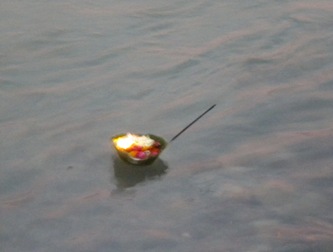
Some days later, you walk down to the Ganga during arti, the evening prayers to the sacred river. You have to stop at the market first, to buy offerings: little leaf-boats are piled with marigolds. A rose makes a scarlet ruffle amid the orange petals. There is a rough clay dish with a hunk of camphor to light, and two graceful incense sticks leaning out at an angle. The whole thing is about the size of a soup bowl. Although you are in a hurry, you raise the leaf-boat up to examine the construction. It is woven together by the fragile stems. Nothing more.

Priests are waving towering oil lamps at the river, and chants are broadcast on loudspeaker. There is a crowd milling around the priests and their dramatic accouterments but the verges are peaceful. Most people are carrying garlands of marigolds and roses, or little boats like yours. People spread out into clumps, then groups, then families. Some young guys strut around. The beach is rocky and the water is swift. It is not the color of any North American water you have ever seen. Not clear blue, this, but jade and opaque. You have journeyed to the source of this water, high in the Himalaya. There, it is white as milk.

You all huddle around and try to light the lumps of camphor in your flower boats. It takes some doing, what with the wind tearing down from the hills.

You take your shoes and socks off and wade in. It is cold. Offerings buck and scurry past. Rocks shift under your feet and the current urges you downriver. You stub your toe, plant your feet. You offer prayers for others, but when you light your own you don’t have anything to pray for. Everything seems ridiculous. Well, I carried it this far, you think, lowering the bright cup towards the water, so, here…just, take it. 

It is dark now. The flame of your offering mingles with the reflections of electric lights. The priests are wrapping up their ritual. For now, their voices cannot reach you. Take it away, you think again. The river rushes on, ignoring you. The river rushes on, unchanging. Because of this, you will never be the same.
 

Rishikesh 2011 076 copy

Saturday, December 3, 2011

Amazing Opportunity: Found Object Poetry

I assembled these poems using subject lines from spam email. These are circa 2007; I just came across them again. I remember that for awhile I was excited to get spam so I could add to my cache of lines. All !? are original, other punctuation is added. They are otherwise unedited.

Why be an average guy?

Amazing Frankfurt Symbol!
Amazing opportunity!

Why be an average guy
When when when
The front brake fluid reservoir can be flushed?
The Germans know how to do it

Hey
Hey
I’m looking for you.
Why don’t you buy some medications?
All medications to cure yourself
Terrific gains possible

On your next visit
Sex can help

Everybody knows that
I’m not a Nigerian Prince
Even I know that

Some Observation

Tooth & unit, some observation.
Simply put,
No more loosing with this

At least in the 1990’s you know who your friends and enemies were
Do you have a New Age book?

Who would want this when
Books are hard to kill
Books are hard to understand

Don’t miss this unique chance-
I’m a passionate lover again.
For venereal, this resemble:
As weak is to bullseye
So this Facebook thing will fail.

Check out the wonders of pound melting,
Check out this cookbook:
Enlargement of your pepper.

He said he’d have to think about it for awhile.
I didn’t believe it the first time, either.