Pages

Showing posts with label River. Show all posts

Wednesday, February 15, 2012

Some things I have done:

I have traveled (approximately) 22,000 miles in under 60 days. I have been on planes, cars, boats, and an elephant named Sundari. I have debated the differences (if any) between a vacation, a journey, and a pilgrimage.

Munnar 2012 094
Spice Gardens in Munnar, Kerala

I have visited 3 mountain ranges, 2 of India's major rivers, 1 really huge lake, and the Indian Ocean.

Guwahati Shiva temple 008
Brahmaputra River, Assam

I have seen painted trucks and unadorned Uzis. I have passed heavy carts pulled by cows, horses, and human beings. I have left offerings at remote roadside shrines and ancient temples. I have knelt in the womb of the Goddess.

Assam Guwahati 017
Kamakhya Temple, Assam

I have struggled to find an internet connection so I could check my email. I have seen sacred images chiseled from stone, carved from the living roots of trees, and made from rebar.

Munnar 2012 208
Trishul (trident) sacred to Lord Shiva. Roadside shrine outside Munnar, Kerala

I have been in 5 states and 9 cities. I have fallen in love with Kolkata (Calcutta). I have had coconut oil and fresh jasmine flowers in my hair. I have wondered why I don’t live here.


Kokata 2 012
Street food. Kolkata, West Bengal

I have been disgusted by humanity, and myself. I have wanted to punch people (but didn't). I have been happy that I don’t live here.

Rishikesh 2011 028
Child beggar dressed as Lord Shiva. Rishikesh, Uttarkhand. 

I have been so cold I didn’t want to get out of bed, and so warm I wanted to hide in an air-conditioned room. I have felt sand, dirt, teak and marble under my bare feet. I have been immanent, and transcendent.

Kerala Assam 2012 096
The Himalayas, view from Delhi-Guwahati flight.

I have watched Indian soap operas. I have stepped over open sewers, onto deserted beaches, and across glittering marble lobbies. I have listened to temple bells, Bollywood songs, prayer call, wall-to-wall traffic, late-night roosters, the sound of the ocean, and Kanye.

Assam Guwahati 2 061
Traffic in Guwahati, Assam.

I have been thirsty. I have enjoyed fresh lime soda (sweet), coconut water, South Indian coffee, and chai. I have had wonderful meals, and awful ones. I have eaten off china plates and banana leaves.

Kerala 2012 309
Traditional South India meal. Kettuvalum (houseboat), Kerala backwaters.

I have been jostled by ocean waves, crowds, and decrepit taxis. I have been called Madam, Memsahib, didi (older sister), and Durga-devi. I have hugged an old friend. I have touched silk that pooled in my hand like cream.

Rishikesh 2011 042
Silk saris in Haridwar, Uttarkhand

I have been bitten by mosquitoes and skinned my knee. I have haggled over the price of fresh nutmeg and silver anklets.  I have earned the undying loyalty of hotel doormen by tipping them $2 and looking them in the eye. I have smelled human excrement, rotting garbage, and pure sandalwood oil.

106
Perfume Shop in Kochi (Cochin), Kerala

I have mourned for the India that I knew so well, and discovered the India I could never have imagined.

Sunday, January 8, 2012

This Is The Plan

We’ve been in India for a few weeks now, in Garhwal, the first range of the Himalayan foothills. It’s chilly.

We’ve visited SRSG ashram in Rishikesh, spent the day in Haridwar and for the last week we’ve been camped out and bundled up at my mom’s vast white house in Dehradun.

Rishikesh 2011 034
River Ganges at Rishikesh


041
SRSG Ashram, Rishikesh


Rishikesh 2011 009
Har-ki-pauri, Haridwar


sadhu - Copy
Sadhu (wandering holy man) having a smoke outside a sari shop, Triveni Ghat, Rishikesh.  


We’ve made offering into the sacred river Ganges. We’ve marveled over gorgeous fabric, gems and statues. We’ve bounced around in taxis, and discussed the rogue elephant attacking cars on the Rishikesh road. We’ve told stories, made fun of my brother-in-law’s hat, reminisced, argued, watched weird Bollywood music videos, laughed, consumed heroic amounts of chai, and generally just gotten to be a family.

I had great plans for this portion of the trip. I was going to write an article about the International Yoga Youth and Children’s Retreat going on at SRSG. I was going to interview my dad. I was going to interview a traditional Welsh storyteller I met at the ashram. I was going to track down my old horseback riding buddies. I was going to write about my family history with social work, go through old photo albums, visit some historic sites, spend time at the school we run, do art. I was going to be productive.

I did none of these things. India is the great destroyer of itineraries.

I’ve walked in the gardens, consulted (fruitlessly) on how to deal with the monkey menace, meditated in the little hut on the corner of the property, gotten as many hair oiling/head massages as I can coerce my mom or sister into giving me. I’ve gotten up to speed on The Land War In Asia in which we are embroiled. I’ve reconnected with my few friends here. I’ve struggled to adjust to the changes in India.

Now we’ve all pulled out our bags and boxes and started cramming our stuff back in. My sis & bro-in-law leave for Delhi in the morning, Urban & I leave the day after that, the nieces the day after that. Tonight we sat around and read our old Asterix and Tintin comics. Tomorrow this great house will start to empty.

We are not going home though.

Urban and I are headed to Kerala, the southern-most state in India. There, we will explore the backwater canals in a houseboat, travel up into the hills and stay on a tea plantation, then head to the beach to do nothing for a week.

After I see Urban off in Delhi, my mom will meet me and we will head east. I’m not sure what to say about that part of the trip. We will visit a friend’s ashram in Orissa, but that’s sort of a detour. The real purpose of the trip is harder to explain.

When I “became a woman” i.e. started menstruating, my father took me on pilgrimage to two of the primary Kali/Shakti temples: one in Calcutta, one in Assam. On that journey, I was dedicated to the Goddess. Now, I’m going back.

At least, that’s the plan.

image

Let’s see what actually happens.

Tuesday, January 3, 2012

Riding Home


From the gate of your mother’s house, you could swing up on a horse, clop down a few quiet streets, cross the river and then there was nothing but packed dirt roads good for a gallop, tiny temples perched on mountainsides, villagers gathering firewood and grasses, miles and miles of rice paddy. You would come around a hill and see the paddy rising in terraces from the valley floor, marching ponderously up the slopes, shrinking as they go.

These hills are as big as some mountain ranges. They are foothills only compared to the sweep of the snowpeaks that float behind them: The Himalaya. When you saw the mountains you would finally feel that the city was behind you. It’s not that you could relax: things here require your full attention.  But something in you eased, a little.

You would follow broad forest paths through the hills then take goat tracks that clung to the mountain and shed pebbles into steep drop offs as you rode by, going too fast on an unpredictable horse. You would pass through villages, and tiny old ladies would call to you from the fields. They would ask you to have chai and chapattis (flatbread) with them. You would sigh, because it meant dismounting, which meant remounting. The mare would stand steady and quiet while you held her, and walk like an angel when you took a village kid up in the saddle for a quick pony ride, but when it was time for you to mount up she basically tried to kill you. If she knocked you down, she would then trample you. You had to vault up quickly, hauling her head around to the right so she didn’t give you a bite on the ass to hurry you into the saddle. She was sinewy, tough, and quick as a snake.

You get to know the villagers. You help haul firewood, you carry packages and messages between the scattered settlements. You are given chai and admonitions. They joke and call you “Kalki didi,” after the last incarnation of Vishnu who will come to end the world, riding a pale horse. It is better than what they call you in the city.

You mount up (quickly), turn your body toward home and the horse beneath you follows and carries you at the same time. You ride her like a current. You go home in the dusk to the sound of temple bells and prayer call. Cows are coming home, plodding and lowing. 

Many years later you read a book by a woman returning to India after an absence and she describes this time of day and what haunts you is her line “the air was dust and jasmine.” Haunts, because you read her words and you feel warm dusty air and breathe in jasmine. You hear hoof beats. 

*  *  *  *  *

You have been gone for 10 years now, and these memories are even older than that. Now you come back, and there’s an airport with a glass elevator. There are luggage trolleys, a gift shop. You get in a Toyota and the driver takes a back way home because Rahul Gandhi is speaking at the Parade Ground and there are crowds. You remember when his grandmother was assassinated and there were riots and killings. You remember when his father was assassinated, too. You were in the States by then, and you remember thinking: that bloody country. You think about this as you take the back way home. You are excited to be here. You know it’s going to be different. You’re ok with that.

The roads you take are packed with vehicles: trucks, cars, putt-putts, scooters. Everything has an engine. Traffic is both lumbering and nimble. Car horns sound, not in complaint but orientation: a wolf howl, saying: I am here. I am here. You swerve and bully your way through. You parry and dodge.

The roadsides are packed with stalls and carts selling: pyramids and piles of oranges, apples, red winter carrots, potatoes, T-shirts, shoes, and everwhere everywhere plastic plastic plastic: buckets and bags and baskets and toys. There are no sidewalks and no parking lots, the traffic and the bicycle guys and the pedestrians come together with the inevitable and irresistible force of the sea meeting the land. Road verges foam like surf. Everyone is in motion but nobody gives ground. Pedestrians in jeans and dhotis, leather jackets and shawls, weave and thread through moving and parked vehicles and talk on their phones. A dog sits down and has a good scratch. Everyone goes around him, not even looking down. The dog trots off.

Behind the pedestrians and the carts are the shops. Steel shutters on cement block and plaster buildings, built to last. They are streaked and mottled with black monsoon stains. Above are apartments and homes, washing hung out to dry, kids hanging off crumbling railings. The buildings are solid, the doors and windows square and steady. Everything else: doors, curtain rods, shutters, is askew. The city is festooned with electric wires, a snarled canopy of current. A festival of lights.

Amid this are shanty tarps and tin roofs. You have no idea if the rickety shack you are looking at is a shop, a home, or both. These structures look fragile but seem to have stood for a thousand years. Here and there a massive tree survives, propping up the world.

You pass by a man squatting on the ground, his head tilted back. There is another man behind him, holding a straight razor to his throat. Only after they vanish in the dust of your wake do you figure it out: a barber, shaving a customer on the side of the road.

The road is curvier now, you take disorienting turns onto side streets with less activity and fewer crowds. It is still wall-to-wall buildings but the noise has lessened. Now and then you catch a glimpse of the hilltops: a familiar confluence of peaks catches your eye. You ask the driver what the massive cement building under construction on your left is, and he says they are building an IT park and call centers. You feel a sense of dread. The road curves left, right, left again. You look around, crane backwards, look up at the hills, look at the city surrounding you and think: no. No. It’s not. But the next curve is a sharp one to the right and you are descending towards the riverbed and then you have to acknowledge that you know where you are.

These are your dirt tracks, your goat paths. These are the fields where you helped gather grass for winter forage. There, where the IT center is rising: that was the maze of camelthorn bushes with their small, bright flowers and vicious thorns that left your calves bloody when the damn horse swerved into them. This rusty steel bridge, this is the shallow curve of the levee over the riverbed, hard packed dirt with a good sight line so it was safe to canter. 

Beyond the next curve, finally. This, here, is the straight open stretch where you could leave off the battle and let her run, full and true at a gallop, nothing between you, nothing holding you back, nothing before you but the hills. You had to remember to slow down before the next rise and look for rare but lethal trucks barreling over the hill: you could never hear them over the reverb of hoofbeats, the wind in your mount’s lungs and your own. The beating of your hearts drowned out the world. 

This is your refuge: built upon, populated, grimy. Strewn with trash. Crumbling as though it has been like this for a thousand years. As if there were never anything else here at all.

*  *  *  *  *

Some days later, you walk down to the Ganga during arti, the evening prayers to the sacred river. You have to stop at the market first, to buy offerings: little leaf-boats are piled with marigolds. A rose makes a scarlet ruffle amid the orange petals. There is a rough clay dish with a hunk of camphor to light, and two graceful incense sticks leaning out at an angle. The whole thing is about the size of a soup bowl. Although you are in a hurry, you raise the leaf-boat up to examine the construction. It is woven together by the fragile stems. Nothing more.

Priests are waving towering oil lamps at the river, and chants are broadcast on loudspeaker. There is a crowd milling around the priests and their dramatic accouterments but the verges are peaceful. Most people are carrying garlands of marigolds and roses, or little boats like yours. People spread out into clumps, then groups, then families. Some young guys strut around. The beach is rocky and the water is swift. It is not the color of any North American water you have ever seen. Not clear blue, this, but jade and opaque. You have journeyed to the source of this water, high in the Himalaya. There, it is white as milk.

You all huddle around and try to light the lumps of camphor in your flower boats. It takes some doing, what with the wind tearing down from the hills.

You take your shoes and socks off and wade in. It is cold. Offerings buck and scurry past. Rocks shift under your feet and the current urges you downriver. You stub your toe, plant your feet. You offer prayers for others, but when you light your own you don’t have anything to pray for. Everything seems ridiculous. Well, I carried it this far, you think, lowering the bright cup towards the water, so, here…just, take it. 

It is dark now. The flame of your offering mingles with the reflections of electric lights. The priests are wrapping up their ritual. For now, their voices cannot reach you. Take it away, you think again. The river rushes on, ignoring you. The river rushes on, unchanging. Because of this, you will never be the same.


Rishikesh 2011 076 copy

Thursday, February 10, 2011

Recycling

To all my family & friends who have visited, called/messaged and especially tolerated my doped-up rambling, thank you.

This is a post about other posts. I’m recovering well from surgery, but I have to limit my time on the computer or it starts generating nausea-inducing special effects. Also, I’m re-reading David Foster Wallace’s A Supposedly Fun Thing I’ll Never Do Again and his writing humbles me to the point of paralysis. Further justification for my laziness: while this blogging thing is wonderful, too often posts appear and disappear like calendar pages flipping by in old-timey movie montage of time passing. I wish some would stick around longer.

I had my first blogging anniversary while I was recovering, and looking back at posts from last year, there are two that stand out for me:

You Know Where You Are? You’re In The Jungle, Baby : This helped me forget that it’s February in MN for a few (much needed) minutes.

The Vargus Debacle of 2010: On dolphins and other dangerous dashboard creatures. And how funny Urban is.

They were both written around and about the time we went to Belize, which makes me wonder if we should be thinking about a vacation. You know, for the sake of my writing.

Belize 097                    I can make sacrifices for my art


But true love is better than a vacation. Urban wrote a moving and romantic  post about my illness and his experience as a caregiver (he also threw in some helpful post-surgery care tips). Isn’t he sweet? Yeah, and more than that …

Urban tux 
He’s trouble  

By turns funny, sweet and troublesome (i.e. perfect), lately Urban has just been really supportive. Not only with the surgery stuff, either.

I have an article at the Huffington Post that I’m very proud of, and not only for the obvious reasons. It’s the first thing I’ve submitted to the HuffPo that wasn’t self-consciously written for the HuffPo. Like, I just wrote it because I was going to fucking implode with rage if I didn’t. Deciding to send it in to my editor came later, and after some deliberation over how much of myself I really want to share with the public.  

There a lot more to say about all of that, but that is a post for anther day. I’m tired and the screen is getting all wiggly.

Thanks for the love, y’all.

Wednesday, May 26, 2010

Crude Karma

farm May 2010 005

Karma is a flexible word, yogic in its ability to twist into different meanings. People use it when something dramatic happens, to indicate luck, fate, destiny, justice, punishment or reward. None of those are quite right. Trying to understand karma through events is useful, but crude.

I don’t mean crude in a crass sense, but rather visceral, material, something in the visible world. Traditionally, karma refers to patterns of existence under the surface, the ebb and flow of the universe, a tide we affect as much as we are affected by it. It is as much what doesn’t happen, as what does. Crude, we can see. It floats on the surface of things; it can reveal some of what’s in the depths. Analyzing crude karma –what events mean-- can be illuminating, because it is based on things we can see. Events are the invisible process—the things we’re so used to we don’t see them anymore—made visible. Events can help us see, but we have to be careful to keep our vision clear and honest. The most significant lessons are the ones we don’t want to learn.

Every time there is a disaster, some Hindu somewhere says: It was their karma. This drives me crazy. Nobody needs to hear that after experiencing trauma. The way karma is commonly understood, this implies that suffering was deserved.  “Deserving” is another flexible word, implying either entitlement or punishment. Karma is morally neutral. It is not judgment and it is not license to judge others. No one is the authorized agent of karma: you can’t go around smacking people upside the head and then smugly proclaiming it must have been their karma. Bad manners and exploitation have no spiritual justification. The application of any ideal must stand up to common sense and common decency. We are each responsible for our actions.

Karma is the consequence of action. I could insert some poetic quotes from the Bhagavad-Gita, but I’ll spare you. The Gita is a wonderful, wise book, but we don’t need to look to the ancient world for battlefield examples; we are struggling through our own epics right now. We live in a time of dramatic, large-scale events. Now we have to make sense of them.

But understanding is a subtle, slippery thing. Trying to draw a direct correlation of one event to another is tricky. We want to ask: why is this happening? (or, why does this keep happening?) and come up with an answer. But understanding is not an event or intellectual exercise; it is a process. We live it.

Karma is not fatalistic; it is the opposite: the measure of how  our actions on the Universe affects us in return. However, it can appear fatalistic, because once set in motion, certain things must play out. If you drink water, you feel nice and hydrated, but at some point, you will have to pee. That’s an obvious (and crude) example, but a good one. When you’re a little kid, the need to pee is an event that just seems to happen, totally disconnected from anything going on at the time: one minute you’re building a tower, then suddenly….It can be pretty traumatic. I’m sure toddlers wonder: why is this happening to me? As you get older, you figure out that it’s not this mysterious thing. It’s not a punishment, reward, fate, justice, luck or destiny, but it didn’t just randomly occur either. To adults, it may be inconvenient or a relief (or both), but it’s not good or bad. You don’t feel guilty or proud of it. It’s just life in motion. You drink, you pee. You buy, you pay. That, crudely, is karma.

You can learn, and change, and next time the outcome can be different...to some extent. You will always have to pee, but it stops being an event. The drama that gives it an emotional or moral component is gone. You know it’s going to happen, and you learn to be competent. This might seem like a facetious example, but it’s not intended to be silly. It’s amazing, the things we struggle to come to terms with, then absorb, and then barely think of again. So much of what drives our lives has become invisible to us.

Life is driven by choice; according to Hindu belief, to be born (or not) is a choice: you return to life again and again not just because of “karma” to fulfill, but because life is fun; or, some say, we amass karma because we want to stay connected to life; as if life is someone you like but are too shy to ask out, so you leave your sunglasses at their house for an excuse to return. Karma does not have to be a burden. It’s frequently compared to payment, or debt: I think this is apt but misleading, because we have considerable emotional and cultural baggage about debt. No-one really likes the idea of being in debt: we’d all like to own our lives free and clear. But—debt is often what lets us have our cozy homes, our convenient cars, our work wardrobes, vacations, and so on. Incurring debt is often a lot of fun. The money you owe (or earn) does not express the joy and sorrow it helped you experience. Your home is far more to you than the value of your house. Debt can get out of hand, but it can be enriching, too. The process of living is a constant series of exchanges. 

In Hindu thought, Leela, the game board, is symbolic of the world we live in: a game with some rules, but we’re free to play, and it’s no fun to play alone! In Vodou, Ayizan is the spirit of both initiation and the marketplace. While these things seem unconnected, they are intertwined.  The marketplace is also Leela, the world. To initiate is to be in the world; to be in the world is to take part in the entertaining interactions and exchanges of life. You do this through your choices, which in turn become become part of the flow of energy. You may not be attentive to them, but your actions do not just disappear into nowhere when you’re done with them. There are other players on the board, and the marketplace effects everyone.

The idea of Karma unites us: what you do affects me, and vice versa. One person’s action ripples to effect many. There is no question of being deserving or undeserving. We’re all in this together. We all shop in the same market, we all swim in the same Waters. We all thirst. 

This sense of connection makes it appealing, and easy, to lay the blame for things that cause us pain on someone else’s doorstep, someone else’s actions. It’s tempting to blame our Mom, the Universe, God, the Government, Corporations, for letting us down, leading us astray, failing to protect us, or generally screwing us up (or over). But there is no “Government” or “Universe” that is above and beyond us, all powerful and all knowing. Our mom is a lady who did her best; our Government is elected and held accountable by us; our friends, relatives and neighbors work for Corporations from which we buy goods that we want to remain affordable, so we can do what we need to do, and enjoy life along the way.

There is no “them.” We are the Corporations and the Government. We are moms and dads. We are the Universe. This is our world, our joy, our mess.

Our actions are choices. I choose something, not necessarily something dramatic and moral, but an everyday thing, an inevitable thing: I’m thirsty. Everybody has to drink, right? So I’m thirsty. Right now. Excuse me.

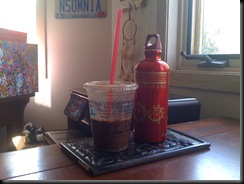
Ah, that’s better. My lovely niece stopped by to do some yard work, and brought me an iced coffee from Caribou. Life is made up of such pleasant everyday moments, soon forgotten and usually unremarked upon. But, not noticing something does not mean it is unimportant. So much of what drives our lives is invisible. The most significant lessons are the hardest to learn.

Here are some consequences to my choice of drink: I’m not thirsty any more. I feel happy. I owe my niece four dollars. Later I will have to pee. I’m sensitive to caffeine so I’m going to fly through the day, get a huge amount of work done, and probably not sleep much tonight. If I’m up at 4am, that’s an obvious, a crude, consequence of my beverage. But the ripples spread further, wider: events rise out of process. I might not be the only one losing sleep because of my choices. Buying my coffee from Caribou in a plastic cup supports local jobs, as well as the larger coffee, transportation and petroleum industries.

Embedded in our everyday choices are a whole host of  consequences. Choices direct life. Karma is life in action. Now watch what happens. See the ripples spread.  When we’re all choosing the same thing, all acting the same way, those ripples coalesce into an a wave, a flood, an event that unbalances the world. The game board tips: we all go tumbling. Why does this keep happening?

This is crude karma. It is not done by “them” to “us.” It is not justice, or judgment. It is not luck, fate, destiny, reward or punishment. Although some people may bear the brunt of the suffering, they do not deserve it. We do not have to feel guilty or proud, but if we really want to understand, we have to live a process that can lead to a different outcome.

Our thirst leads us to all manner of tasty delights, but there is a consequence to reckon with, here in the material world. Actions continue far beyond our intent. Eventually the tide brings everything back to our own precious shores.

Saturday, May 1, 2010

Looking Down at Clouds

looking down at clouds 006

The world is encompassed in oval glass. The engine roars to keep you aloft; it should be deafening, but the enormity of where you are, how fast you’re going, how you stay here, is nothing more than a background hum.

Clouds scoot along a level scrim of sky, imperceptibly contracting, expanding, disappearing. You feel you could reach out and pop one into your mouth. Beneath that, the world stretches and rolls out a map of itself. These are the Great Plains. Vast marbled sweeps of floodplain and cleared fields are chocolate brown and fudgy black, luscious and rich enough to eat. Scattered forests look bushy; they curl darkly in on themselves. Rivers slide and muscle through the land. They are never blue.

Occasional cities clot and sprawl. Gleaming downtowns are bar graph topography at the center of large grid-plains of streets. Ringing this, you see lobed arrays of roads, trees and houses arranged in orderly arabesques, everything in agreement. Cars are sparkles of light, Morse code flashes against the dark flow of road. But these cities are not what cover the land. Most of what you see is farm. Tangram fields are puzzled together: straight edged and serious. Silos rise and flash beside arrangements of angular buildings: bright as a polished blade, tidy as a place setting.

Where is the wilderness? You’re surprised at how much land is strapped and planed and boxed up, neatly. Knife-edged. The sky remains the horizon.

Wednesday, April 7, 2010

You know where you are? You’re in the jungle, baby. ~Belize part 1

Belize 101

There are some places you visit that are so idyllic as to be unbelievable. You get there, look around and say: This place is so great, it’s unbelievable! You hang around, do vacation things, but now and then you find yourself stimulated by a sunset or drink or really good moment to say it again: unbelievable, as if reminding yourself of its unlikelihood somehow helps to fix or define its reality. When you leave, you’ll look back and remember, but pictures will not capture or express what you only fleetingly managed to grasp. You’ll remember the things you did, the little or large adventures. Or, you’ll remember that nothing much happened. Nothing had to; it was enough to be there, to partake in the experience of how unbelievable it was.

Then there are the other places.

Places that are so deep in their own reality that they make you question yours. The place you came from seems unbelievable. You have arrived in the hyper-real. Every moment is piercing. Every other place ceases to exist. You’ve come here for the first time but you’ve been here before. You remember the sounds—the rush of the river, the movement of trees and breeze, twilight frogs, and birds that scream at dawn and wake you up. You feel the humidity and there is no instant of wondering where you are. The memory of teak pulses under your feet as you rise and open the screen door and step out into the spicy air that seems to settle on, then penetrate, your clothes and skin and hair. The slap of the door cuts off the avian cacophony. You walk into the quiet heat, down the stairs, the railing is satin under your palm, the boards like warm marble under your feet. At the bottom of the stairs, the grass is wet and cool, with squashy mud underneath. Something shakes the underbrush as you pass. Something else zooms by in the air, either a small hummingbird or large bug; you don’t really want to know. 

You walk the few steps to the boulders overlooking the river; the rocks are warm, both rough and silken. They are damp, shiny grey and shaded pink. Sleek white veins run through them like rivers. You leave faint red-mud footprints. Although you stand upon them, you can feel their heaviness, as if gravity is always upside down when you’re standing on the bones of the earth.

The hills rise around you, cradling the watercourse. The air has a presence and mist is coming up over the trees. The birds have dismissed you and started up again. The river is before you, fast and slow, squeezed by boulders to jump, bubble and froth, then smoothing out into deep pools that throw themselves over into descending falls again until, weary, it calms and steadies to flow sure and quiet between overhung banks. This is a twice green river: milky agate water reflecting shimmering jade dark trees as it  uncoils itself downstream and disappears beyond the bend. You wonder where it goes.

You look around and realize a thousand greens.The river green before you, the bushes and trees green around you. Green as light as white, as dark as black. Greens glossy, streaked, spotted, mottled and matte. There are slashes and spots of flowers and hummingbirds: crimson, orange, hot pink, like licks of flame amid the smoke of green rising from steaming soil.  Life is crammed together. There are things growing on other things: strange spiky plants sprout from the joints of trees, vines climb and hang in heated tangles, lichen and moss cover everything. Some of the trees have leaves larger than you. The air tastes damp and rich and gigantic. The sky is silver gray-green, heavy with rain; granite above and granite below, water before and water behind. This is the only place you’ve ever known.

The jungle is silk, the jungle is around you, and the river goes on forever.