Pages

Showing posts with label America. Show all posts

Friday, December 14, 2012

Three Strangers

I am in Target. It is full of crabby shoppers and harried staff. I am just entering the aisle of 10,000 Christmas Things when my Tardis ringtone starts: rrrrWOOOrrrrWOOOrrrrWOOO… rrrrWOOOrrrrWOOOrrrrWOOO… rrrrWOOOrrrrWOOOrrrrWOOO…. (What’s a Tardis? you wonder. Here: more than you wanted to know, but you asked for it.)

A lady in the same aisle, coolly assessing wrapping paper, predictably  glances up, has no interest in the Tardis or me, and goes back to it. Suddenly, a (tired, stressed-looking) Target Employee comes running around the corner, yelling “TAKE ME WITH YOU, DOCTOR!” He nearly knocks me over.

Alarmed, the lady asks: “Is he ok? Are you a doctor? Should I call an ambulance?” Mr. Target Employee & I look at each other and start laughing like loons. We can’t stop. Wrapping Paper Lady looks affronted. He finally collects himself and says to her “Sorry, ma’am. It’s a geek thing. Happy Holidays.”

Then he shakes my hand, turns, and returns from whence he came.

I am still grinning when I walk out of the store. I am still grinning when a friend texts me one word: Connecticut. My smile fades as I scroll through my Twitter feed to find out what’s going on. The news is fresh and contradictory, but one thing is clear: some asshole walked into a school and killed a bunch of little kids. Holy fuck. Little kids.

The face of every kid I love shines behind my eyes. Then: no. Don’t go there.

I drive over to my sister’s house. It’s where I go when things feel rough, you know? We talk for awhile, about how horrible it is, how it’s not happening to us, yet it is happening to us. I mean, we’re fine. But…we’re all one family in the end. But we’re not. But it could happen to anyone, to anyone’s kids. But it didn’t, it happened to specific people and specific kids. It shouldn’t happen to anyone. But it does. All the time. All we can conclude is that little kids are dead, it’s messed up, and we feel helpless and terrible. In this moment, I am happy that I don’t have children. By the time I leave, my mind is back on my errands.

I stop at a gas station. As I walk up to the door, I see a guy in a Massive Pick-Up Truck (I live in the land of MPUTs). His head is down and his shoulders shaking. He looks up and I see tears running down his face.

Hesitating a bit, I go over to his window. He rolls it down. Big, burly dude, wearing a farm-battered Carhartt coat.

Me: “Are you ok? Are you sick?” Flashback to TAKE ME WITH YOU, DOCTOR!

Him: “No…I’m not sick. I’m not ok. I just dropped my boy off at practice, and I keep thinking about those kids in Connecticut. All those kids. And I just keep thinking of my kid…” He starts crying, hard. I reach into the window and take his hand. I start crying, too, of course.

I stand there and cry with this guy (I never got his name). He finally gives my hand a squeeze and lets go. He says thanks. I say, same goes. He rolls up his window, Puts his MPUT in gear, and goes. I sit in The Red Barron (my car) until I calm down. It never really happens, but I have to head home. I take the long way, feeling awful, and sniffling.

I am halfway home when: fuck this. I turn the radio on, and crank it loud. It helps. I’m waiting at a stoplight and singing along to LCD Soundsystem’s Daft Punk Is Playing at My House (My House), when I look over and see this kid in a Toyota, also singing his heart out. After a minute, I realize, Holy Shit! He’s singing the same song.  He notices me, does a double take as he realizes the same thing, rolls his windows down, and turns the music UP. I do the same. Winter air washes over me. The bassline makes our cars shiver. We howl along.

We don’t move until the cars behind us start honking. He waves once, and turns the corner.


Monday, September 10, 2012

Messages to the Ancestors…


Last year I wrote a piece called “Flesh and Bone: Honoring Ancestors” for State of Formation. The article, and the issues I raise in it, have continued to haunt me. Our disconnection from and fear of our dead: why is this so often the stuff of horror movies? Why do we make our dead into monsters? These are our departed loved ones, our community, our history. Why do we fear them? I felt like the article was the start of something but I didn’t know what else to do. Write another article?

We were brainstorming new ideas for the Fifth Annual Anba Dlo Halloween Festival at the New Orleans Healing Center: how can we make the spiritual principles represented by Halloween fun and engaging? How can we recognize and express our heritage while doing some good for people in the city we all love? I was trying to think of an interactive project to host in the Spiritual Space.

BAM! It hit me. Messages to the Ancestors. An easy, practical and beautiful way to reach out to our departed ones. A way to ease our guilt and fear, to forge a small connection based in love. To say what might have been unsaid, to soothe our regrets. Maybe a way to make a small peace. I envisioned messages sent as a blog comment, via email, or written out by attendees on the night of the festival, then displayed in the ascetic but resonant 4th floor Spiritual Space. Even more fitting, the adjacent rooftop space will be hosting the 10,000 Bones exhibit (these bones represent a protest against genocide). So we’ll have the symbolic bones of our ancestors keeping company with the created bones of artistic protest against the harms we do to each other. I like that.

Peristlye Gede altar

I had the idea roughed out and ready to go…then I got (Viral) Meningitis and lost nearly a month of work time. As  recovered and scrambled to get ready to leave for Burkina Faso for a month, I kept worrying about this project. It got pushed back and back. I finally got the website launched the night before I left…and realized that now, the timing felt right: the eve of my departure to Africa, home of all of our ancestors.

So, please: visit Messages to the Ancestors. Reach into your history, reach within you, reach forward into a future where you are at peace with your past. Leave a message.

Tuesday, November 23, 2010

Monday, November 1, 2010

Flesh and Bone

skull

The wheel of the year has spun around again. Today is the Day of the Dead, All Soul’s Day, All Saint’s Day. Today, I remember and pay respects to my predecessors: my beloved departed ones, teachers of my spiritual traditions, folk hero(ine)s who inspire me, artists and writers who humble me, scholars who provide my intellectual foundation, and the nameless ancients whose gift is my DNA. We are the living flesh on the bones of these ancestors.

A relationship does not end just because one person passes away.  We carry our dead with us: in our DNA, our memories, our hang-ups, our culture. But after their death, we can choose to have a relationship with the best part of someone, and let the worst parts go. We can forgive them.

We are defined by our relationships. In some ways, we are relevant only as part of a community. Your history, life and fate of are not distinct from the history, life and fate of your community. My definition of community used to only include people who live in my time zone, as it were. I don’t mean Central Daylight Time: I mean, people who are alive at the same time as me. But the truth is that we are supported and influenced by the dead as much as the living: community looks like a circle, but it is actually a sphere that crosses the visible and invisible realms. The community is our bones. 

My physical ancestors’ bones are part of the rich soil of India and the Caribbean. The land I live on now is contains the bones of Native American people and pioneers of European descent. My intellectual and moral heritage is built on the bones of scholars, artists, warriors and healers of heritages too countless to name. While my spiritual traditions are Neo-Pagan, Vodou and Hindu, this practice of honoring one’s ancestors is practiced across the globe. 

It is not ancestor “worship” any more than throwing a birthday party for someone is worshipping them. And it looks much the same: food is offered, candles are lit, we stand around and sing. For this one day, they are the center of the circle. We acknowledge their importance to us, and honor their essential spirit.

We should not dwell in grief, but neither should we forget our dead ones. They are our bones. Bones are strength. They literally hold us up.

When you see images of bones, do you shudder? One of the reasons people tell me they fear of Vodou is “all the bones:” images of the skeletal Spirits of the Dead. Why do we fear the dead? Why is the idea of departed ones a source of horror? Vodou empowered me to confront and overcome my own fear, to build a healthy relationship with the dead.

The Vodou I practice is based in New Orleans, but that is based in Haiti and the Caribbean, which in turn is based in Africa. Follow anything back far enough, you’ll end up in Africa. Africa is our bones.

West African philosophy charts an intersection of ancestors, community and time. You seem to believe that time marches ever onward: what is gone is discarded as you look eagerly forward. We live in the present and the future is before us. The past is history. This is not true. You may not be able to see it, but the past is your bones.

The African concept of time and community helps us understand this. In the West African system, there are two kinds of time: Sasa and Zamani. Sasa is encompassed by the memory of the community's eldest to the potential lifetime of the youngest. This is “immediate” time, the time of the living. Zamani is “far” time, the temporal geography in which the consciousness of all the community’s dead and unborn reside. It is heritage and hope. It the well from which both tradition and innovation spring. It is a sphere made up of many circular time-lines. It looks forwards and backwards in the same direction. Zamani encompasses Sasa like a womb, cradles, supports and nourishes it.  The future is the past returning, but we make it our own. Sasa is the flesh; Zamani, the bones.

Strip us bare: we are bones. The skeleton is us, seen through the mirror of time.

As we come around again to this time of year when the bones of the trees are laid bare, take a moment to connect with Zamani. Honor those who helped create the reality you dwell in. Let yourself love your departed ones. You cannot see them, but they are there, deep within, supporting you. Share their stories. Hold their wisdom. Forgive your dead.

Do not be afraid. Remember your bones.

Monday, October 4, 2010

American Shakti

Versions of this essay be viewed at The Washington Post On Faith blog,  and The HASC site, where you can also learn more about ShaktiSeva.

What is Shakti?

You already know.

Beyond any definition I can give you, beyond explanations drawn from scripture and authorities, is the true meaning of Shakti that each woman knows. It is true because it is your Shakti. It is the part of yourself that you reach into, the deep well that most of us discovered when we had nowhere else to turn. Shakti empowers us into ourselves, empowers us to be ourselves. When you look within for inspiration, solace, guidance, it is Shakti that gives answer and Shakti that acts through you. It is the wisdom of your great-great-great-grandmother, encoded in your bones, the wisdom of the all-Mother that rises through each of us. It is the effervesce of life. Shakti does not only exist in women, but it is through women that it flows. It is our essential foundation, and it is that which goads us to change.

Shakti is a Sanskrit word, but Shakti is beyond religion, race or nation. While the Hindu calendar recognizes Navratri (the nine nights of the Goddess), we are Hindus living in the wheel of Americans seasons. In Euro-American folk traditions, these seasons are significant: autumn is time to enjoy the harvest, to prepare for the quiet wild of winter. As we enter autumn, the air grows crisp, the days grow brief, and we grow introspective. As the days darken, the leaves brighten. We see the colours of the Goddess: gold, orange, red. The season lights its dia to Devi.

There is wisdom in autumn. Feel the city gird itself against the chill, the throngs of people shiver in the wind and wonder at the sky. Become a dragon, breathing steam in the morning. Hear the Goddess as she rustles through the corn, as she revels in the bounty. Feel her readiness for the reaping, the preparation of the long contemplation of winter. As the nights grow longer, let her sing you to sleep. See the trees dress up in their best, then scatter their garments to meet Winter with smooth, bare limbs. Feel the living roots reach deep into the warm beating flesh of our Mother Earth. Feel that power rise to greet the sun, to revel beneath the moon. All this is Devi, the Goddess. This is mother, sister, daughter. This is you and me. This is Shakti.

As that power comes through it becomes: we make it what it is. Whether you are in the boardroom or bedroom, you know the feeling. Shakti is power and Shakti is play. Shakti is the warm womb of the kitchen and the cool bravery of the battlefield. She is the quiet moment when we gather and the brilliant light when we shine. She is what all women know. She is without form yet encompassed by each of our forms. She is beyond and within. Shakti is the current that flows beneath the current.

Shakti is what is shared when women gather: not the essential but superficial knowledge of doing but the deep instinctive knowledge of being. Shakti is not chosen, and we cannot control it. It the flood, the rush of endorphins, the giddy laugh, the flash of insight, the swirl of energy through the cosmos. We ride it like a wave.

This is what Shakti is to me. What is Shakti to you?

This month of October, this season of autumn and Navrathri, take the time to find, explore and express your Shakti. Reach out. Create. Heal.

Celebrate Navratri in a way that is meaningful to you. Nine nights in a row, observe a ritual: it may be traditional, invented or a combination of the two.

  • Honor the Deities, Folk Heroes, Activists, Writers, Artists, Innovators, Politicians…the women…who inspire you.
  • Forgive a friend who wronged you.
  • Light your altar and chant the ancient prayers, then light a candle and take a bath.
  • Adorn yourself.
  • Arrange events to be inspired by or inspire others with your shakti stories
  • Start a journal, a blog, share your stories
  • Give yourself permission to create something.
  • Revive an old love: sing, dance, paint.
  • Write a letter.
  • Call your sister, friend, mother.
  • Have your friends over: share the profound and silly female bonding rituals of your heritage and youth: oil your hair, do henna, paint your nails.
  • Go out for the evening.
  • Sign up for a class: make pottery; learn to play the drums, knit a scarf.
  • Get moving: go for a walk, learn to ride a horse, take up a martial art.


Just as you already know what Shakti is, you know, deep inside, who you are.

This autumn, tend the light that glows within.

Rediscover yourself. Invent yourself. Become yourself. Most of all: revel in yourself.

Saturday, September 11, 2010

Sunrise: 6:55am

Urban had an appointment on the 80th floor of the South Tower at 8am on September 11th, 2001.

I was going to tag along (to NYC & the Twin Towers) and take a tour of the building. On September 8th, the overseas colleague he was scheduled to meet got sick and said he was unable to make the trip. Everything was cancelled. No NYC, no tour, no visiting friends, nothing. I remember we were both quite irritated. Urban ran his own business and last-minute, out-of-state cancellations cost us money. It was nobody’s fault.

We had planned to be away, so we went to Wisconsin instead. We were at The House on the Rock when we heard the news. Now, if you’ve ever been to The House on the Rock, you can imagine what that must have been like. If you’ve never been there, I’m not even going to try and explain. Maybe another time.

Anyway, we made it back to our hotel and sat horrified in front of the TV with the rest of the nation. It was many hours before either of us remembered where we had originally planned to be that morning. I can still feel the look on my face.

9/11 tore a hole in the world. I don’t know why I’m here to peer through from this side. I can’t believe that “someone was looking out for me.” That implies that someone was not looking out for the thousands of people who died. The thousands of people that we watched die. I just don’t believe that The Great Whatever is a micromanager, or maybe any kind of manager at all. I also don’t (like to) believe that my entire existence is mere chance. Some guy in Japan got the flu. I got to live.

We all remember where we were. We don’t often get the opportunity to remember where we weren’t. Life is unfathomable. We never know where it will end (up).

One thing is sure...every 9/11 around 6am, having been awake all night remembering, wondering and praying in my own weird way, the sun will come up and the sight of that rising light, the re-brightening of our world, will make me burst into tears. 

I search for words I don't have…and feel the life that I do.

Tuesday, August 31, 2010

Dear Friend, The Majority of People Can Still Be Wrong

The thing I always wonder about Nazi Germany is this: how did it happen? Did all the Germans just go insane? How does an entire culture get to the point that they can turn away and ignore the torture and murder of MILLIONS of people: and not far away, hidden from view people, but people they pass by on the street, people they do business with, people that are their neighbors? How do people support a political party that treats people, based on their religion/culture, as a problem that must be solved? Well, I think it helps that Germans were scared of “them.” Really scared.

It’s hard to reason with fear.

From: Saumya Arya Haas
Sent: Tuesday, August 24, 2010 6:01 PM
To: xxxxxxx
Subject: RE: Cold Chills

Hello Dear xxxxxxx,

It was truly wonderful to see you! and thank you for giving me the chance to respond to Wilders’ speech/ideas.

Regardless of what I say here… if you would like to know what Muslims think, you should get to know some Muslims and ask them, rather than basing your opinions on what someone else (including me) thinks that Muslims think.  However that’s not practical right away, so here is my response, based on my instincts, my experience with actual Muslims, living in India where Hindu-Muslim violence is not uncommon, being familiar with terrorist attacks (from many different groups: religious, political, secular, ethnic, etc.) in various parts of the world from a young age, and being an extremely patriotic American. It’s a long reply so bear with me.

Geert Wilders, the writer of this piece, is considered an extremist by many people. He is up on hate-speech charges in his native country, where no established political party will be associated with him. The UK tried to ban him from entering their country.

http://en.wikipedia.org/wiki/Geert_Wilders

There is so much wrong with the reasoning in this article that I do not know where to start. Here is only one, minor, example. He says (about “Muslim ghettos”) :

“The shops have signs you and I cannot read. You will be hard-pressed to find  any economic activity.” Well, which is it? Are there shops, where presumably, people are exchanging money for products… or is there no economic activity?

What would you think of an architect who said “The pipes leak water everywhere. There is no plumbing in the house.” You would think they were mistaken, lying, or insane. How much would you trust their other statements?

Where are the references for his claims on facts and figures? is there reputable, government supported information, or are these figures produced by partisan organizations with an particular agenda? And if they are correct, so what? People can say, think and believe whatever they like. It is actions that count, and even that is does not justify discrimination. I’ve heard it said that the majority of convicted criminals in the USA are young African-American men. Should we treat all young Black guys like potential criminals? Lock them up just to be safe?

When you read Wilders piece, is there any other group that you would be comfortable generalizing about in this way? If you take out the word “Muslim” and insert the word “Black,” “Gay,” “Women,””Jewish,” whatever, how does it make you feel?  People call Wilder’s views racist and extremist because they are. As far as quoting numbers of what percentage of people fear Islam, I wonder, what percentage of Americans supported the abolition of slavery, women’s right to vote, interracial marriage, Civil Rights, etc, etc.? Do you think that if 60% of Americans are afraid of young African-American men we should do something about it? I’ve read that when it became legal for whites and non-whites to marry, the majority of Americans were against it. (I bring this one up because I’m in an interracial marriage and I know you would find it as distasteful as I do that there was a time that Urban & I, both American citizens, could not legally marry in our own country.)

The majority of people can still be wrong.

Wilder’s arguments and solution (which is not stated, but I am familiar with) do not stand up to common sense, common decently, the American Constitution or international human rights guidelines. People become criminals, and can be treated as criminals, the minute they are found guilty of a crime. Each person deserves to be treated as an individual. What crime have millions of Muslims committed, that we are so comfortable talking about them as though they are guilty of something? If Muslims are 25% or whatever of the population of Europe, so what?  Europe is made up of many nations and cultures; Muslims have been a part of that since Islam has existed.

The questions about Israel is a separate, political issue about governmental policies, not what citizens think. I know a number of (white, Jewish) Americans who are critical of Israel for whatever reasons. I’m not sure what that has to do with anything.

Wilder advocates against dialogue with Muslim leaders; I find that disturbing. His writing is full of absolute statements and hysteria.

I feel that Wilders’ speech and writings follow this formula and philosophy:

“It [does] not investigate the truth objectively and.. it present[s] only that aspect of the truth which is favourable to its own side. (...) [It is] confined to a few bare essentials and those must be expressed as far as possible in stereotyped formulas. These slogans [are] persistently repeated (…) Every change.. must always emphasize the same conclusion. The leading slogan must of course be illustrated in many ways and from several angles, but in the end one must always return to the assertion of the same formula.”

This is very effective because:

“[People]are ruled by sentiment rather than by sober reasoning. This sentiment, however, is not complex, but simple and consistent. It is not highly differentiated, but has only the negative and positive notions of love and hatred, right and wrong, truth and falsehood.”

These quotes are from Hitler, Mein Kampf.

Have you ever read the anti-Jewish rhetoric from Germany in the 1930s? It sounds very much the same. It was just as passionate, just as popular, and just as based on “facts.”

This is my theory: Germans believed that they had to protect themselves against an enemy, and that their survival depended on destroying this enemy before the enemy destroyed them. Germans began to believe that people who had lived peacefully alongside them, contributed to their economy and enriched their culture,  were dangerous outsiders who did not belong in Germany. I’m sure there were some Jews that were unprincipled, dangerous criminals—people are human after all. So, one Jew committing a crime became “proof” of the evil nature of all Jews. Jewish “ghettos” were portrayed as cancerous, dangerous cells that would spread and wipe out European values. Does any of this sound familiar?

What is Wilders solution? The mass rounding up and “deportation” of millions of people? Does that sound familiar?

The other thing I wonder about Nazi Germany is this: When was the moment? When did the German people tip from the talk to the walk? How did it go from free speech to state-sponsored genocide? Why didn’t anyone say: enough is enough. We are terrified of Jews, but we don’t have the right to eradicate them. Did any one say: We must stop before we do something insane.  If we look back with the luxury of hindsight, I think it’s apparent that there was not one moment, but many. Many.

The only cold chills I get are imaging what will happen to millions of innocent people if politicians like Wilder come into power.

I would like to be open and be able to talk about these issues, and I would like you to be comfortable talking to me. You are my friend and I love and respect you. But emails like the one you forwarded are hate speech, nothing more. I support the right of free speech for all, but it is a challenge to know how to reasonably respond to such virulent hatred masquerading as fact.

It’s ok to be ignorant and it’s understandable to be scared of things and cultures that we don’t understand. But it is not okay when our ignorance and fear is justification to limit the rights of other people…actually, there is nothing that justifies limiting the rights of other people. I cannot stand by in silence while my fellow (Muslim/Gay/Jewish/Whatever) Americans and fellow humans are demonized and have their dignity & rights stripped from them. These people are innocent. Where is this thinking going to end up?

I hope that you understand, and that your intrinsic compassion, intelligence and sense of justice will advise your thoughts and feelings.

With best intentions and much love,
Saumya

Friday, August 13, 2010

I’ll help you pack, even.

Dear People-Who-Are-Afraid-of-Islam-And-Think-Your-Fear-Should-Affect-Other-People's-Freedoms,

You have a right to your feelings. But you do not have to right to expect your feelings to limit the rights of other Americans.

The 9/11 terrorists were angry, violent, screwed-up people, ok? Muslim, male, young, Middle-Eastern, dark-skinned, angry, violent, screwed-up. It's the angry, violent, screwed-up action that makes a terrorist. Nothing else.

Islam has nothing to do with terrorism, or, it has as much to do with terrorism as does ethnicity, national origin, age and gender...which is to say, nothing. We may as well associate maleness with terrorism...all the 9/11 terrorists were men. That's just as (ir)relevant as the fact that they were Muslim.

Most terrorists are men. Many cultures of "manhood" advocate violence, but I haven't noticed a backlash against male culture as terrorism. Imagine people making statements, writing tweets and articles or holding signs that say:

We will be overtaken by MEN, and their goal is to get people in Congress.

It’s provocative for these MEN to want a community center near Ground Zero.

Don’t Dishonor my Son’s Grave. No MEN Near Ground Zero.

It’s ridiculous, right? It’s ridiculous no matter what word is substituted for “MEN.”

There is a word for generalizing about people who practice a particular religion, look a particular way, or are a particular gender: it is called BIGOTRY and it is not protected by the Constitution of the United States, or any rational, moral or ethical argument.

So, get over the Islam thing. Or shut the hell up, let people worship as they choose and get some professional help for your anger, insecurity and paranoia. Or move out of the USA to a nation that does not give people the right of religious freedom. (Did Saudi Arabia come to mind? One of those nations run by…MEN?) If you can’t respect the basic beliefs of this country: Liberty and Justice for All—then it’s you who doesn’t belong here.

Best Wishes,
Saumya

P.S. If you’re wondering what triggered this rant, it was this article:
Festive Muslim Holiday falls around Sept. 11 this year; US Muslims leaders fear backlash

It pisses me off that people in our country have to be afraid of celebrating their holidays. If terrorism is using fear to intimidate and control people, or words to that effect, and the Muslim community is afraid of us, who is it that is advocating terrorism??

Wednesday, May 26, 2010

Crude Karma

farm May 2010 005

Karma is a flexible word, yogic in its ability to twist into different meanings. People use it when something dramatic happens, to indicate luck, fate, destiny, justice, punishment or reward. None of those are quite right. Trying to understand karma through events is useful, but crude.

I don’t mean crude in a crass sense, but rather visceral, material, something in the visible world. Traditionally, karma refers to patterns of existence under the surface, the ebb and flow of the universe, a tide we affect as much as we are affected by it. It is as much what doesn’t happen, as what does. Crude, we can see. It floats on the surface of things; it can reveal some of what’s in the depths. Analyzing crude karma –what events mean-- can be illuminating, because it is based on things we can see. Events are the invisible process—the things we’re so used to we don’t see them anymore—made visible. Events can help us see, but we have to be careful to keep our vision clear and honest. The most significant lessons are the ones we don’t want to learn.

Every time there is a disaster, some Hindu somewhere says: It was their karma. This drives me crazy. Nobody needs to hear that after experiencing trauma. The way karma is commonly understood, this implies that suffering was deserved.  “Deserving” is another flexible word, implying either entitlement or punishment. Karma is morally neutral. It is not judgment and it is not license to judge others. No one is the authorized agent of karma: you can’t go around smacking people upside the head and then smugly proclaiming it must have been their karma. Bad manners and exploitation have no spiritual justification. The application of any ideal must stand up to common sense and common decency. We are each responsible for our actions.

Karma is the consequence of action. I could insert some poetic quotes from the Bhagavad-Gita, but I’ll spare you. The Gita is a wonderful, wise book, but we don’t need to look to the ancient world for battlefield examples; we are struggling through our own epics right now. We live in a time of dramatic, large-scale events. Now we have to make sense of them.

But understanding is a subtle, slippery thing. Trying to draw a direct correlation of one event to another is tricky. We want to ask: why is this happening? (or, why does this keep happening?) and come up with an answer. But understanding is not an event or intellectual exercise; it is a process. We live it.

Karma is not fatalistic; it is the opposite: the measure of how  our actions on the Universe affects us in return. However, it can appear fatalistic, because once set in motion, certain things must play out. If you drink water, you feel nice and hydrated, but at some point, you will have to pee. That’s an obvious (and crude) example, but a good one. When you’re a little kid, the need to pee is an event that just seems to happen, totally disconnected from anything going on at the time: one minute you’re building a tower, then suddenly….It can be pretty traumatic. I’m sure toddlers wonder: why is this happening to me? As you get older, you figure out that it’s not this mysterious thing. It’s not a punishment, reward, fate, justice, luck or destiny, but it didn’t just randomly occur either. To adults, it may be inconvenient or a relief (or both), but it’s not good or bad. You don’t feel guilty or proud of it. It’s just life in motion. You drink, you pee. You buy, you pay. That, crudely, is karma.

You can learn, and change, and next time the outcome can be different...to some extent. You will always have to pee, but it stops being an event. The drama that gives it an emotional or moral component is gone. You know it’s going to happen, and you learn to be competent. This might seem like a facetious example, but it’s not intended to be silly. It’s amazing, the things we struggle to come to terms with, then absorb, and then barely think of again. So much of what drives our lives has become invisible to us.

Life is driven by choice; according to Hindu belief, to be born (or not) is a choice: you return to life again and again not just because of “karma” to fulfill, but because life is fun; or, some say, we amass karma because we want to stay connected to life; as if life is someone you like but are too shy to ask out, so you leave your sunglasses at their house for an excuse to return. Karma does not have to be a burden. It’s frequently compared to payment, or debt: I think this is apt but misleading, because we have considerable emotional and cultural baggage about debt. No-one really likes the idea of being in debt: we’d all like to own our lives free and clear. But—debt is often what lets us have our cozy homes, our convenient cars, our work wardrobes, vacations, and so on. Incurring debt is often a lot of fun. The money you owe (or earn) does not express the joy and sorrow it helped you experience. Your home is far more to you than the value of your house. Debt can get out of hand, but it can be enriching, too. The process of living is a constant series of exchanges. 

In Hindu thought, Leela, the game board, is symbolic of the world we live in: a game with some rules, but we’re free to play, and it’s no fun to play alone! In Vodou, Ayizan is the spirit of both initiation and the marketplace. While these things seem unconnected, they are intertwined.  The marketplace is also Leela, the world. To initiate is to be in the world; to be in the world is to take part in the entertaining interactions and exchanges of life. You do this through your choices, which in turn become become part of the flow of energy. You may not be attentive to them, but your actions do not just disappear into nowhere when you’re done with them. There are other players on the board, and the marketplace effects everyone.

The idea of Karma unites us: what you do affects me, and vice versa. One person’s action ripples to effect many. There is no question of being deserving or undeserving. We’re all in this together. We all shop in the same market, we all swim in the same Waters. We all thirst. 

This sense of connection makes it appealing, and easy, to lay the blame for things that cause us pain on someone else’s doorstep, someone else’s actions. It’s tempting to blame our Mom, the Universe, God, the Government, Corporations, for letting us down, leading us astray, failing to protect us, or generally screwing us up (or over). But there is no “Government” or “Universe” that is above and beyond us, all powerful and all knowing. Our mom is a lady who did her best; our Government is elected and held accountable by us; our friends, relatives and neighbors work for Corporations from which we buy goods that we want to remain affordable, so we can do what we need to do, and enjoy life along the way.

There is no “them.” We are the Corporations and the Government. We are moms and dads. We are the Universe. This is our world, our joy, our mess.

Our actions are choices. I choose something, not necessarily something dramatic and moral, but an everyday thing, an inevitable thing: I’m thirsty. Everybody has to drink, right? So I’m thirsty. Right now. Excuse me.

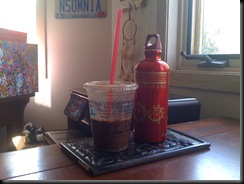
Ah, that’s better. My lovely niece stopped by to do some yard work, and brought me an iced coffee from Caribou. Life is made up of such pleasant everyday moments, soon forgotten and usually unremarked upon. But, not noticing something does not mean it is unimportant. So much of what drives our lives is invisible. The most significant lessons are the hardest to learn.

Here are some consequences to my choice of drink: I’m not thirsty any more. I feel happy. I owe my niece four dollars. Later I will have to pee. I’m sensitive to caffeine so I’m going to fly through the day, get a huge amount of work done, and probably not sleep much tonight. If I’m up at 4am, that’s an obvious, a crude, consequence of my beverage. But the ripples spread further, wider: events rise out of process. I might not be the only one losing sleep because of my choices. Buying my coffee from Caribou in a plastic cup supports local jobs, as well as the larger coffee, transportation and petroleum industries.

Embedded in our everyday choices are a whole host of  consequences. Choices direct life. Karma is life in action. Now watch what happens. See the ripples spread.  When we’re all choosing the same thing, all acting the same way, those ripples coalesce into an a wave, a flood, an event that unbalances the world. The game board tips: we all go tumbling. Why does this keep happening?

This is crude karma. It is not done by “them” to “us.” It is not justice, or judgment. It is not luck, fate, destiny, reward or punishment. Although some people may bear the brunt of the suffering, they do not deserve it. We do not have to feel guilty or proud, but if we really want to understand, we have to live a process that can lead to a different outcome.

Our thirst leads us to all manner of tasty delights, but there is a consequence to reckon with, here in the material world. Actions continue far beyond our intent. Eventually the tide brings everything back to our own precious shores.

Saturday, May 1, 2010

Looking Down at Clouds

looking down at clouds 006

The world is encompassed in oval glass. The engine roars to keep you aloft; it should be deafening, but the enormity of where you are, how fast you’re going, how you stay here, is nothing more than a background hum.

Clouds scoot along a level scrim of sky, imperceptibly contracting, expanding, disappearing. You feel you could reach out and pop one into your mouth. Beneath that, the world stretches and rolls out a map of itself. These are the Great Plains. Vast marbled sweeps of floodplain and cleared fields are chocolate brown and fudgy black, luscious and rich enough to eat. Scattered forests look bushy; they curl darkly in on themselves. Rivers slide and muscle through the land. They are never blue.

Occasional cities clot and sprawl. Gleaming downtowns are bar graph topography at the center of large grid-plains of streets. Ringing this, you see lobed arrays of roads, trees and houses arranged in orderly arabesques, everything in agreement. Cars are sparkles of light, Morse code flashes against the dark flow of road. But these cities are not what cover the land. Most of what you see is farm. Tangram fields are puzzled together: straight edged and serious. Silos rise and flash beside arrangements of angular buildings: bright as a polished blade, tidy as a place setting.

Where is the wilderness? You’re surprised at how much land is strapped and planed and boxed up, neatly. Knife-edged. The sky remains the horizon.