Pages

Showing posts with label Ocean. Show all posts

Wednesday, February 15, 2012

Some things I have done:

I have traveled (approximately) 22,000 miles in under 60 days. I have been on planes, cars, boats, and an elephant named Sundari. I have debated the differences (if any) between a vacation, a journey, and a pilgrimage.

Munnar 2012 094
Spice Gardens in Munnar, Kerala

I have visited 3 mountain ranges, 2 of India's major rivers, 1 really huge lake, and the Indian Ocean.

Guwahati Shiva temple 008
Brahmaputra River, Assam

I have seen painted trucks and unadorned Uzis. I have passed heavy carts pulled by cows, horses, and human beings. I have left offerings at remote roadside shrines and ancient temples. I have knelt in the womb of the Goddess.

Assam Guwahati 017
Kamakhya Temple, Assam

I have struggled to find an internet connection so I could check my email. I have seen sacred images chiseled from stone, carved from the living roots of trees, and made from rebar.

Munnar 2012 208
Trishul (trident) sacred to Lord Shiva. Roadside shrine outside Munnar, Kerala

I have been in 5 states and 9 cities. I have fallen in love with Kolkata (Calcutta). I have had coconut oil and fresh jasmine flowers in my hair. I have wondered why I don’t live here.


Kokata 2 012
Street food. Kolkata, West Bengal

I have been disgusted by humanity, and myself. I have wanted to punch people (but didn't). I have been happy that I don’t live here.

Rishikesh 2011 028
Child beggar dressed as Lord Shiva. Rishikesh, Uttarkhand. 

I have been so cold I didn’t want to get out of bed, and so warm I wanted to hide in an air-conditioned room. I have felt sand, dirt, teak and marble under my bare feet. I have been immanent, and transcendent.

Kerala Assam 2012 096
The Himalayas, view from Delhi-Guwahati flight.

I have watched Indian soap operas. I have stepped over open sewers, onto deserted beaches, and across glittering marble lobbies. I have listened to temple bells, Bollywood songs, prayer call, wall-to-wall traffic, late-night roosters, the sound of the ocean, and Kanye.

Assam Guwahati 2 061
Traffic in Guwahati, Assam.

I have been thirsty. I have enjoyed fresh lime soda (sweet), coconut water, South Indian coffee, and chai. I have had wonderful meals, and awful ones. I have eaten off china plates and banana leaves.

Kerala 2012 309
Traditional South India meal. Kettuvalum (houseboat), Kerala backwaters.

I have been jostled by ocean waves, crowds, and decrepit taxis. I have been called Madam, Memsahib, didi (older sister), and Durga-devi. I have hugged an old friend. I have touched silk that pooled in my hand like cream.

Rishikesh 2011 042
Silk saris in Haridwar, Uttarkhand

I have been bitten by mosquitoes and skinned my knee. I have haggled over the price of fresh nutmeg and silver anklets.  I have earned the undying loyalty of hotel doormen by tipping them $2 and looking them in the eye. I have smelled human excrement, rotting garbage, and pure sandalwood oil.

106
Perfume Shop in Kochi (Cochin), Kerala

I have mourned for the India that I knew so well, and discovered the India I could never have imagined.

Sunday, February 5, 2012

Music for Mountain Roads

Things I associate with other things:
The MN State Fair and mini-donuts
Bare feet and the beach
The smell of alcohol and hospitals
Indian mountain roads and very loud music through headphones

*   *   *   *   *   *

On the way down from the hill town of Munnar, we bounce and shimmy over a road that is almost wide enough for two vehicles to pass comfortably. Sometimes, leaping around a switchback, we meet another vehicle. Both lurch to a halt. The drivers communicate with complicated hand signals and abrupt jerks of their chins. Usually the coming-down-the-mountain vehicle reverses, maneuvering backwards up a hairpin turn or two. We find a place to squeeze by, like a passenger in the window seat scooting up to the airplane aisle. Now imagine doing that if, instead of the seatbacks in front of you, there’s nothing but a drop-off and empty air. I peer out my window as we rattle past a truck; it may as well be 10,000 feet down.

As soon as we’re clear, the car sprints forward. This is less of a flat-race than hurdles: we spend a great deal of time partially airborne, crashing back to the road with elephantine grace. I hold the Oh, Jesus handle. (Would that be a Hai-Ram handle in India?) Unlike the USA, where the Oh, Jesus handle is so called because it’s what passengers grab in an emergency or accident, here in India, these situations are so constant they lose urgency. You learn to hold the handle (or the prayer, if you swing that way) the whole time. You keep your bag zipped up so that when it is flung onto the floor all your stuff doesn’t fall out and roll around. My headphone cord is arranged in such a way that it will not strangle me if I am flung onto the floor (learned that the hard way); the phone it is plugged into is wedged carefully so it does not become a projectile (same incident). 

I am listening to Kanye West: aggressive, misogynistic, smart and melodic: Everybody knows I’m a motherfucking monster. I turn it up all the way. The sound is fantastic.

I have (have always had) diverse musical tastes. Growing up, I was as likely to listen to Air Supply as Iron Maiden, Billy Joel as Peter Tosh. But when it came time to buck over the narrow, nearly vertical paths and ruts of the Himalaya of my childhood, I always chose the loudest, most parent-disapproval-earning, ear-drum-punishing sound for my headphones. When I was young, it was as much escape from my family as anything else. I don’t know why I do it now.

Kanye threatens, howls and opines: I mean this shit is, fucking ridiculous…

I listen to the pounding bass and observe the bewildering tragicomedy of Indian billboards: smiling sari-clad women loaded in gold jewelry, a child sprays water at an Audi, half-dressed men lurk on motorcycles and scowl, happy couples jump for joy, a swami floats beatifically over a temple, a group of anxious people are menaced by a gigantic snake. There are signs for something called Globstar Sofas (that is not a typo). Every single person in every single ad could pass for white. The signs are mostly in Malayalam, a language I can’t read or speak. Besides the sofas, I have no idea what the ads are for. Movies? Wedding jewelry? Undershirts? Motorcycles? White folks?

Praises due to the most high Allah
Praises due to the most fly Prada
Baby, I’m magic. Ta-da!

I settle my sunglasses more firmly on my face (they will shake lose again in a couple of minutes) and glance over at Urban. He is wearing a fine, cream-colored cotton shirt, and a lungi (the sarong-like garment traditionally worn by Indian men). It looks good with his fair skin, unruly blonde hair, and the ease with which he carries himself. His eyes are closed and he counts prayer beads on his mala: he is meditating. I look down at myself: I am wearing capris and a shirt I bought at Ridgedale. Kanye thumps and cusses in my ears.

We got nothing to lose, motherfucker, we rolling. Motherfucker, we rollin. With some light-skinned girls…

I am the Indian one, although all the Indians in the billboards now rushing past at roughly the speed of sound have complexions closer to Urban’s than my own.

Ain’t no question if I want it: I need it. I can feel it slowly drifting away from me…

We pass painted trucks & indifferent cows, sometimes whipping by inches away. A group of shirtless men squat by the roadside drinking chai. A young woman in a pink salwar kameez roars by on a motorcycle. Our eyes meet. She does a double-take at Urban and gives me a grin and a nearly suicidal thumbs-up.

Would you rather be underpaid or overrated?
(I consider this line for some time, and try to imagine a scenario where I would have to choose between these two options. Then I realize that I already have both. This makes me happy.)

Turn up the lights in here, baby: extra bright, I want you to see this.

Urban finishes his mala, digs around for his headphones, and plugs them into my phone. This is possible due to a device that goes with me everywhere. I call it The Nifty Dual Headphone Jack Adapter Thingy. Getting all this technology out of bags and connected while the car jumps and spins takes some doing. Now Urban is trying to take pics of the billboards while holding on to the Hai-Ram handle with one hand. I turn the music down for him, a little. Kanye is picking up steam:

No more drugs for me; pussy and religion is all I need. Grab my hand and baby, we’ll live a hell of a life.

We pass a bus with an Indian-looking Mighty Mouse emblazoned on the back. Urban & I grin delightedly. We reach out to each other, but the car careens around a corner, and we have to clutch our respective handles to avoid being thrown across the bench seat and out my open window.

Exchanging amazed glances at the world outside, the same music in our ears, we can’t hold hands because the ride’s too wild. Coming down the mountain, hurtling toward the sea: we have no idea what we’ll find there.

That’s one hell of a life.

Wednesday, May 26, 2010

Crude Karma

farm May 2010 005

Karma is a flexible word, yogic in its ability to twist into different meanings. People use it when something dramatic happens, to indicate luck, fate, destiny, justice, punishment or reward. None of those are quite right. Trying to understand karma through events is useful, but crude.

I don’t mean crude in a crass sense, but rather visceral, material, something in the visible world. Traditionally, karma refers to patterns of existence under the surface, the ebb and flow of the universe, a tide we affect as much as we are affected by it. It is as much what doesn’t happen, as what does. Crude, we can see. It floats on the surface of things; it can reveal some of what’s in the depths. Analyzing crude karma –what events mean-- can be illuminating, because it is based on things we can see. Events are the invisible process—the things we’re so used to we don’t see them anymore—made visible. Events can help us see, but we have to be careful to keep our vision clear and honest. The most significant lessons are the ones we don’t want to learn.

Every time there is a disaster, some Hindu somewhere says: It was their karma. This drives me crazy. Nobody needs to hear that after experiencing trauma. The way karma is commonly understood, this implies that suffering was deserved.  “Deserving” is another flexible word, implying either entitlement or punishment. Karma is morally neutral. It is not judgment and it is not license to judge others. No one is the authorized agent of karma: you can’t go around smacking people upside the head and then smugly proclaiming it must have been their karma. Bad manners and exploitation have no spiritual justification. The application of any ideal must stand up to common sense and common decency. We are each responsible for our actions.

Karma is the consequence of action. I could insert some poetic quotes from the Bhagavad-Gita, but I’ll spare you. The Gita is a wonderful, wise book, but we don’t need to look to the ancient world for battlefield examples; we are struggling through our own epics right now. We live in a time of dramatic, large-scale events. Now we have to make sense of them.

But understanding is a subtle, slippery thing. Trying to draw a direct correlation of one event to another is tricky. We want to ask: why is this happening? (or, why does this keep happening?) and come up with an answer. But understanding is not an event or intellectual exercise; it is a process. We live it.

Karma is not fatalistic; it is the opposite: the measure of how  our actions on the Universe affects us in return. However, it can appear fatalistic, because once set in motion, certain things must play out. If you drink water, you feel nice and hydrated, but at some point, you will have to pee. That’s an obvious (and crude) example, but a good one. When you’re a little kid, the need to pee is an event that just seems to happen, totally disconnected from anything going on at the time: one minute you’re building a tower, then suddenly….It can be pretty traumatic. I’m sure toddlers wonder: why is this happening to me? As you get older, you figure out that it’s not this mysterious thing. It’s not a punishment, reward, fate, justice, luck or destiny, but it didn’t just randomly occur either. To adults, it may be inconvenient or a relief (or both), but it’s not good or bad. You don’t feel guilty or proud of it. It’s just life in motion. You drink, you pee. You buy, you pay. That, crudely, is karma.

You can learn, and change, and next time the outcome can be different...to some extent. You will always have to pee, but it stops being an event. The drama that gives it an emotional or moral component is gone. You know it’s going to happen, and you learn to be competent. This might seem like a facetious example, but it’s not intended to be silly. It’s amazing, the things we struggle to come to terms with, then absorb, and then barely think of again. So much of what drives our lives has become invisible to us.

Life is driven by choice; according to Hindu belief, to be born (or not) is a choice: you return to life again and again not just because of “karma” to fulfill, but because life is fun; or, some say, we amass karma because we want to stay connected to life; as if life is someone you like but are too shy to ask out, so you leave your sunglasses at their house for an excuse to return. Karma does not have to be a burden. It’s frequently compared to payment, or debt: I think this is apt but misleading, because we have considerable emotional and cultural baggage about debt. No-one really likes the idea of being in debt: we’d all like to own our lives free and clear. But—debt is often what lets us have our cozy homes, our convenient cars, our work wardrobes, vacations, and so on. Incurring debt is often a lot of fun. The money you owe (or earn) does not express the joy and sorrow it helped you experience. Your home is far more to you than the value of your house. Debt can get out of hand, but it can be enriching, too. The process of living is a constant series of exchanges. 

In Hindu thought, Leela, the game board, is symbolic of the world we live in: a game with some rules, but we’re free to play, and it’s no fun to play alone! In Vodou, Ayizan is the spirit of both initiation and the marketplace. While these things seem unconnected, they are intertwined.  The marketplace is also Leela, the world. To initiate is to be in the world; to be in the world is to take part in the entertaining interactions and exchanges of life. You do this through your choices, which in turn become become part of the flow of energy. You may not be attentive to them, but your actions do not just disappear into nowhere when you’re done with them. There are other players on the board, and the marketplace effects everyone.

The idea of Karma unites us: what you do affects me, and vice versa. One person’s action ripples to effect many. There is no question of being deserving or undeserving. We’re all in this together. We all shop in the same market, we all swim in the same Waters. We all thirst. 

This sense of connection makes it appealing, and easy, to lay the blame for things that cause us pain on someone else’s doorstep, someone else’s actions. It’s tempting to blame our Mom, the Universe, God, the Government, Corporations, for letting us down, leading us astray, failing to protect us, or generally screwing us up (or over). But there is no “Government” or “Universe” that is above and beyond us, all powerful and all knowing. Our mom is a lady who did her best; our Government is elected and held accountable by us; our friends, relatives and neighbors work for Corporations from which we buy goods that we want to remain affordable, so we can do what we need to do, and enjoy life along the way.

There is no “them.” We are the Corporations and the Government. We are moms and dads. We are the Universe. This is our world, our joy, our mess.

Our actions are choices. I choose something, not necessarily something dramatic and moral, but an everyday thing, an inevitable thing: I’m thirsty. Everybody has to drink, right? So I’m thirsty. Right now. Excuse me.

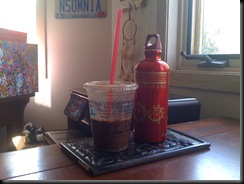
Ah, that’s better. My lovely niece stopped by to do some yard work, and brought me an iced coffee from Caribou. Life is made up of such pleasant everyday moments, soon forgotten and usually unremarked upon. But, not noticing something does not mean it is unimportant. So much of what drives our lives is invisible. The most significant lessons are the hardest to learn.

Here are some consequences to my choice of drink: I’m not thirsty any more. I feel happy. I owe my niece four dollars. Later I will have to pee. I’m sensitive to caffeine so I’m going to fly through the day, get a huge amount of work done, and probably not sleep much tonight. If I’m up at 4am, that’s an obvious, a crude, consequence of my beverage. But the ripples spread further, wider: events rise out of process. I might not be the only one losing sleep because of my choices. Buying my coffee from Caribou in a plastic cup supports local jobs, as well as the larger coffee, transportation and petroleum industries.

Embedded in our everyday choices are a whole host of  consequences. Choices direct life. Karma is life in action. Now watch what happens. See the ripples spread.  When we’re all choosing the same thing, all acting the same way, those ripples coalesce into an a wave, a flood, an event that unbalances the world. The game board tips: we all go tumbling. Why does this keep happening?

This is crude karma. It is not done by “them” to “us.” It is not justice, or judgment. It is not luck, fate, destiny, reward or punishment. Although some people may bear the brunt of the suffering, they do not deserve it. We do not have to feel guilty or proud, but if we really want to understand, we have to live a process that can lead to a different outcome.

Our thirst leads us to all manner of tasty delights, but there is a consequence to reckon with, here in the material world. Actions continue far beyond our intent. Eventually the tide brings everything back to our own precious shores.

Wednesday, April 21, 2010

Immersion ~Belize part 2

Belize 059

I always have some fear when I swim out the first time, after an absence from the Sea. I love the Ocean, but depths frighten me.

It is especially unnerving because right now I can’t see anything; this is not the clear brochure blue Caribbean but a slightly marshy seaside with a muddy floor. The waves stir everything up and visibility is about what I expect in a blizzard, except with coral heads and parrotfish suddenly materializing in front of me. We have vague directions to the little reef (“About 200 yards North off the dock of the house with the barking dogs”). We periodically stop, pop our heads out of the water and pull our facemasks up to squint at the shore. The waves have a different idea of which way we should be heading, and disagreeing with them is tiring. The water is choppy and not really that warm. I tread water and try to untangle strands of my hair from the clasp that holds snorkel to mask; I hear them rip. I yank the mask down, lower my head, and swim. The snorkel sometimes offers air, other times, salt water. My breath sounds amplified, loud and fast: Darth Vader having a panic attack. I feel both claustrophobic and exposed. I try to relax and slow my breathing, which only makes me realize how not-relaxed I am.

I feel simultaneously afraid, foolish for being afraid, and afraid of showing my fear. Are fish like tigers? Can they smell fear? I feel like turning around and swimming back for shore, back to where I can see what’s coming at me.

I’m tired. I float for a minute, facedown, bobbing. My limbs relax.  My back is warm then cool, warm then cool, as small waves come between flesh and sun. Out of the gloom a 5 ft Eagle Ray soars by in slow motion. My head turns to follow its glide. The waters swirl, then I am alone again.

I stop breathing for a moment. Silence rushes in my ears. This is what being a priestess is like.

I have spent so much time gazing at the surface of the Waters. It is mirrored. It’s all the same Ocean, but there is a lot of publicity about the clear places where you can see below. I never seem to end up there. I always end up in the obscure, muddy parts, where the light bounces off the surface. There’s only one way to know what’s there. I wade until the ground drops out from under me and I’m forced to swim. Any given directions are vague, meaningless once I’m on on my way.

I paddle through a vast and murky Sea, not sure where I’m going, not sure what I’ve come to see, not sure I really want to be out here at all. 

Immersion is a constant caress, both distant and intimate. Invisible currents carry me along; I fight against them, wanting to go my own way. I am beneath the surface, but barely. There are unimagined depths below. I do not understand the nature or intentions of the deep, or what may dwell there. The speculation chills me. I long to see, but fear the encounter. Things seem to appear out of nowhere and I am startled by their grace, their belonging to this place. I flounder around, awkward and scared; my tension only makes it worse. Insight is only a byproduct of exhaustion. Be still and listen. Nothing can give me the release I am seeking; I have only been struggling against myself. I am more water than flesh: I am made of the substance I am immersed in. I have been gliding farther into myself, into my own Waters. I am the deep.

My breaths are the waves beneath the waves. Movement is effortless. The depths I fear are what bear me up.