Pages

Tuesday, June 8, 2010

Home Office

I am trying to work in my home office, while other work is going on in the house. There are a couple of guys updating the security system, which produces a regular & piercing beeping sound, like, well, like an alarm going off. The dogs, sensibly, are alarmed, and bark loudly in response. To be fair, this is their job, so my annoyance feels mean-spirited. It is cold and rainy; they can't be outside where there is no (or at least muffled) beeping. Sadly, neither can I. I have a  significant amount of work to get through today, so I am trying to ignore the noise and stay focused. I am also doing A LOT of deep breathing.

My nonchalant attitude towards the ongoing home invasion and resultant Very Loud Noise is deeply troubling to the dogs. They have come to the conclusion that I am deaf to the beeping and must be informed of it by other means. When it beeps, they bark. At me. Barnabas, a 65 lb Shepherd mix, has a weirdly high-pitched, jackhammer yap: wha! wha! wha-wha-wha-wha! wha! Shiduri, the 100 lb Great Dane, does not bark, but rather bays, deeply and loudly, like a submarine siren: Ah-AH-AH-AHWHOO! AHWOOOOOOOOOO! She is exactly ear level with me. 

When the beeping mercifully stops, the canine tweeter & woofer team strut around importantly, clearly feeling that they have frightened away the interlopers. After a couple of grumbled threats in the direction of the front door, they finally relax, and lay down on their doggie beds…we all sigh… just in time for the next terrible BEEP! which sends them scrambling and barking, and then the whole cycle repeats itself. This started at 8am. It’s now 4.

I think the noise hurts the dogs ears so I put cotton balls in them. They don't like it. At first, Shiduri shakes her head violently while she’s barking, which adds a Doppler effect, which only intensifies the siren-like quality of her bays. I feel the vibration in my sternum.  By now she is overcome by the futility of it all and has decided that this awful situation is Barnabas's fault. She commences barking at HIM. He tries to cram himself under my feet. One of the work guys comes in to ask a question.The phone starts ringing.

Why the hell do we have an alarm system? Anyone in their right mind would flee from the dogs.

Wednesday, May 26, 2010

Crude Karma

farm May 2010 005

Karma is a flexible word, yogic in its ability to twist into different meanings. People use it when something dramatic happens, to indicate luck, fate, destiny, justice, punishment or reward. None of those are quite right. Trying to understand karma through events is useful, but crude.

I don’t mean crude in a crass sense, but rather visceral, material, something in the visible world. Traditionally, karma refers to patterns of existence under the surface, the ebb and flow of the universe, a tide we affect as much as we are affected by it. It is as much what doesn’t happen, as what does. Crude, we can see. It floats on the surface of things; it can reveal some of what’s in the depths. Analyzing crude karma –what events mean-- can be illuminating, because it is based on things we can see. Events are the invisible process—the things we’re so used to we don’t see them anymore—made visible. Events can help us see, but we have to be careful to keep our vision clear and honest. The most significant lessons are the ones we don’t want to learn.

Every time there is a disaster, some Hindu somewhere says: It was their karma. This drives me crazy. Nobody needs to hear that after experiencing trauma. The way karma is commonly understood, this implies that suffering was deserved.  “Deserving” is another flexible word, implying either entitlement or punishment. Karma is morally neutral. It is not judgment and it is not license to judge others. No one is the authorized agent of karma: you can’t go around smacking people upside the head and then smugly proclaiming it must have been their karma. Bad manners and exploitation have no spiritual justification. The application of any ideal must stand up to common sense and common decency. We are each responsible for our actions.

Karma is the consequence of action. I could insert some poetic quotes from the Bhagavad-Gita, but I’ll spare you. The Gita is a wonderful, wise book, but we don’t need to look to the ancient world for battlefield examples; we are struggling through our own epics right now. We live in a time of dramatic, large-scale events. Now we have to make sense of them.

But understanding is a subtle, slippery thing. Trying to draw a direct correlation of one event to another is tricky. We want to ask: why is this happening? (or, why does this keep happening?) and come up with an answer. But understanding is not an event or intellectual exercise; it is a process. We live it.

Karma is not fatalistic; it is the opposite: the measure of how  our actions on the Universe affects us in return. However, it can appear fatalistic, because once set in motion, certain things must play out. If you drink water, you feel nice and hydrated, but at some point, you will have to pee. That’s an obvious (and crude) example, but a good one. When you’re a little kid, the need to pee is an event that just seems to happen, totally disconnected from anything going on at the time: one minute you’re building a tower, then suddenly….It can be pretty traumatic. I’m sure toddlers wonder: why is this happening to me? As you get older, you figure out that it’s not this mysterious thing. It’s not a punishment, reward, fate, justice, luck or destiny, but it didn’t just randomly occur either. To adults, it may be inconvenient or a relief (or both), but it’s not good or bad. You don’t feel guilty or proud of it. It’s just life in motion. You drink, you pee. You buy, you pay. That, crudely, is karma.

You can learn, and change, and next time the outcome can be different...to some extent. You will always have to pee, but it stops being an event. The drama that gives it an emotional or moral component is gone. You know it’s going to happen, and you learn to be competent. This might seem like a facetious example, but it’s not intended to be silly. It’s amazing, the things we struggle to come to terms with, then absorb, and then barely think of again. So much of what drives our lives has become invisible to us.

Life is driven by choice; according to Hindu belief, to be born (or not) is a choice: you return to life again and again not just because of “karma” to fulfill, but because life is fun; or, some say, we amass karma because we want to stay connected to life; as if life is someone you like but are too shy to ask out, so you leave your sunglasses at their house for an excuse to return. Karma does not have to be a burden. It’s frequently compared to payment, or debt: I think this is apt but misleading, because we have considerable emotional and cultural baggage about debt. No-one really likes the idea of being in debt: we’d all like to own our lives free and clear. But—debt is often what lets us have our cozy homes, our convenient cars, our work wardrobes, vacations, and so on. Incurring debt is often a lot of fun. The money you owe (or earn) does not express the joy and sorrow it helped you experience. Your home is far more to you than the value of your house. Debt can get out of hand, but it can be enriching, too. The process of living is a constant series of exchanges. 

In Hindu thought, Leela, the game board, is symbolic of the world we live in: a game with some rules, but we’re free to play, and it’s no fun to play alone! In Vodou, Ayizan is the spirit of both initiation and the marketplace. While these things seem unconnected, they are intertwined.  The marketplace is also Leela, the world. To initiate is to be in the world; to be in the world is to take part in the entertaining interactions and exchanges of life. You do this through your choices, which in turn become become part of the flow of energy. You may not be attentive to them, but your actions do not just disappear into nowhere when you’re done with them. There are other players on the board, and the marketplace effects everyone.

The idea of Karma unites us: what you do affects me, and vice versa. One person’s action ripples to effect many. There is no question of being deserving or undeserving. We’re all in this together. We all shop in the same market, we all swim in the same Waters. We all thirst. 

This sense of connection makes it appealing, and easy, to lay the blame for things that cause us pain on someone else’s doorstep, someone else’s actions. It’s tempting to blame our Mom, the Universe, God, the Government, Corporations, for letting us down, leading us astray, failing to protect us, or generally screwing us up (or over). But there is no “Government” or “Universe” that is above and beyond us, all powerful and all knowing. Our mom is a lady who did her best; our Government is elected and held accountable by us; our friends, relatives and neighbors work for Corporations from which we buy goods that we want to remain affordable, so we can do what we need to do, and enjoy life along the way.

There is no “them.” We are the Corporations and the Government. We are moms and dads. We are the Universe. This is our world, our joy, our mess.

Our actions are choices. I choose something, not necessarily something dramatic and moral, but an everyday thing, an inevitable thing: I’m thirsty. Everybody has to drink, right? So I’m thirsty. Right now. Excuse me.

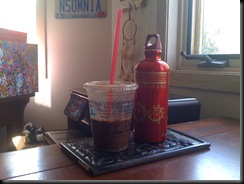
Ah, that’s better. My lovely niece stopped by to do some yard work, and brought me an iced coffee from Caribou. Life is made up of such pleasant everyday moments, soon forgotten and usually unremarked upon. But, not noticing something does not mean it is unimportant. So much of what drives our lives is invisible. The most significant lessons are the hardest to learn.

Here are some consequences to my choice of drink: I’m not thirsty any more. I feel happy. I owe my niece four dollars. Later I will have to pee. I’m sensitive to caffeine so I’m going to fly through the day, get a huge amount of work done, and probably not sleep much tonight. If I’m up at 4am, that’s an obvious, a crude, consequence of my beverage. But the ripples spread further, wider: events rise out of process. I might not be the only one losing sleep because of my choices. Buying my coffee from Caribou in a plastic cup supports local jobs, as well as the larger coffee, transportation and petroleum industries.

Embedded in our everyday choices are a whole host of  consequences. Choices direct life. Karma is life in action. Now watch what happens. See the ripples spread.  When we’re all choosing the same thing, all acting the same way, those ripples coalesce into an a wave, a flood, an event that unbalances the world. The game board tips: we all go tumbling. Why does this keep happening?

This is crude karma. It is not done by “them” to “us.” It is not justice, or judgment. It is not luck, fate, destiny, reward or punishment. Although some people may bear the brunt of the suffering, they do not deserve it. We do not have to feel guilty or proud, but if we really want to understand, we have to live a process that can lead to a different outcome.

Our thirst leads us to all manner of tasty delights, but there is a consequence to reckon with, here in the material world. Actions continue far beyond our intent. Eventually the tide brings everything back to our own precious shores.

Friday, May 14, 2010

Svaha~I make this offering

*Here is another one from the archives, circa 2000.

I am not this, consumed by flame; I am not that, washed in water;
I am not that which drew air, nor am I that which walked upon the earth.
I am the earth, I am the air and I am the water.
I am the fire.
All that which is impermanent, I leave behind.
Svaha svaha, svaha, it is no more mine.

My father is dead. I watched it happen, as he performed his own funeral service on the banks of the Ganges. I have heard that Sanskrit phrase, svaha, it is no more mine, over and over again, my entire life. It is said with every offering given on the altar, into a consecrated fire or sacred river. In my family, it is said with humor and resignation, over opportunities or items lost. Our mental shrug, Oh, well, its gone.

That ceremony transformed my father, my Tata, into something else: a Swami, beyond definitions of family, gender, religion. He began a journey away from of me and mine, and sought a life of service. Swamis were not a mystery to me; I grew up with Baba, a guru who initiated me into our tradition when I was six years old. I felt lucky, even as a kid, to know him. He made a family of everyone who needed one. He made the world magical.

When I was nineteen, my dad, struggling with diabetes and a heart condition, was given a last chance by the doctors: a triple by-pass. This was back in the days when heart surgery was a thing of fear and miracles. In the voice that lulled me to sleep as a child with countless guided relaxations (oh, how I relished being able to make him yell when I was a teenager!) he told me that his life was coming to an end, one way or another. He wished to survive, but if he did, it would not be as it was. It was time. He would begin the process of transition towards Swamihood. My mother would care for him after surgery. They would live together as brother and sister for a time. They would part eventually, husband and wife no longer. Not divorce, he stressed, as though I didn’t know. He would renounce his former life, his family. Our father was leaving us for God.

It seemed natural that this was happening. When he said that he would need his children’s formal blessing, I was startled, as if he was asking our permission to stay out late. I must have talked about it with my siblings, my friends, but I have no recollection. I don’t remember feeling rejected or abandoned. It was actually kind of exciting, as if he had won The Nobel Prize or something. Tata was ours, but never only ours. We always shared him with so much, his books, his disciples and his mission. Much was shared with us in return.

Watching him chant his own funeral prayers was another thing. His familiar voice rising and falling, rising and falling as he sang the ancient hymns. I remember sitting in the mild mountain sun, catching my brother’s eye, and thinking, our father is dying.

I am grateful for the Swami who rose from that pyre, although it took awhile to sort things out. What do I call him? (settled on “Tata Swami”) How do I introduce myself? I can’t say “I’m his daughter” anymore, can I? Or can I? There were a few awkward years where no-one was sure how to behave, what was acceptable. This was new territory for all of us. I avoided him.

My relationship with Swami Veda is very different now, but that’s to be expected, I’m not a teenager anymore. I got over my joy of being able to make him raise his voice. Instead I have found pride, solace and inspiration in watching him become. My father had always been a teacher, but a Swami is something more. And he has become more to me than a father. I look forward to the few times a year that I see him, long nights when we sit up and talk. We have an ongoing debate: Are things as they always have been or does the world really change? We argue but also laugh a lot. He still loves to tell jokes, most of them based on awful and elaborate multi-lingual puns. Through Swami Veda, I have finally gotten to know my dad.

No matter what paths I walk, they are extensions of an ancient tradition. I believe the teachings of the mountain sages, teachings repeated in the Bible, Koran, Torah. Teachings spoken by priests and shamans and druids, wisdom based on experience of living: Know thyself. Let go of what limits you. Respect others. Swami Veda has brought that to countless people. He has acquired the weighty title of Maha-mandalashvar, a Swami among Swamis. He has been responsible for bringing the leaders of Buddhism and Hinduism together for the first time in twenty-three centuries, to be the first ambassador of Hinduism in China in I don’t know how long. I may only see him a few times a year, but when I am really in trouble, it’s his phone that rings in the night, where ever he is. When I sit down to meditate, it is his voice in my head…relaaax your shoulders…breathe deeply, slooowly, smoooothly. The echo of the father I let go.

I don’t think it will be so easy to let Swami Veda go, which is ironic.

Not today or tomorrow, not in the next six months, but, holy or not, he is going to die, to make that final life change. I have seen it, under the mountain sun. This time, I am afraid. When Baba died, I knew there was no-one who could replace him; but we had Swami Veda. I had Swami Veda. When he is gone, who is left? Who will be there for me?

And I find when I ask that question, I have trouble meeting my own eyes; for who is left is looking back at me. You skirt around it in your own way; for me it comes down, bluntly, to selfishness. I want mine, my life, my choices, my freedom. I wanted my father. I want the illusion of owning my life…even if I know it’s an illusion. But I am a child of our tradition; I am my father’s daughter. The voice in my head has become my own.

There is no “one” who will take over, who will be Our Father. Who will be mine.

It is exhausting to fight your own truth; I imagine it must be a great relief to finally, totally, just be yourself. I understand why traditions of self-knowledge are not so popular. Revelation can be very disruptive. Compassion is hard work. Surrender takes some getting used to. Our voices are useless if we don’t share them.

I grow tired of the bondage of mine. I know I am not this that walks, breathes, which someday will be washed and burned. I hope that I will have the strength to look at this life I have hoarded so selfishly and be able to someday say, with relief, svaha, it is no more mine. And then live it.

Saturday, May 1, 2010

Looking Down at Clouds

looking down at clouds 006

The world is encompassed in oval glass. The engine roars to keep you aloft; it should be deafening, but the enormity of where you are, how fast you’re going, how you stay here, is nothing more than a background hum.

Clouds scoot along a level scrim of sky, imperceptibly contracting, expanding, disappearing. You feel you could reach out and pop one into your mouth. Beneath that, the world stretches and rolls out a map of itself. These are the Great Plains. Vast marbled sweeps of floodplain and cleared fields are chocolate brown and fudgy black, luscious and rich enough to eat. Scattered forests look bushy; they curl darkly in on themselves. Rivers slide and muscle through the land. They are never blue.

Occasional cities clot and sprawl. Gleaming downtowns are bar graph topography at the center of large grid-plains of streets. Ringing this, you see lobed arrays of roads, trees and houses arranged in orderly arabesques, everything in agreement. Cars are sparkles of light, Morse code flashes against the dark flow of road. But these cities are not what cover the land. Most of what you see is farm. Tangram fields are puzzled together: straight edged and serious. Silos rise and flash beside arrangements of angular buildings: bright as a polished blade, tidy as a place setting.

Where is the wilderness? You’re surprised at how much land is strapped and planed and boxed up, neatly. Knife-edged. The sky remains the horizon.

Wednesday, April 21, 2010

Immersion ~Belize part 2

Belize 059

I always have some fear when I swim out the first time, after an absence from the Sea. I love the Ocean, but depths frighten me.

It is especially unnerving because right now I can’t see anything; this is not the clear brochure blue Caribbean but a slightly marshy seaside with a muddy floor. The waves stir everything up and visibility is about what I expect in a blizzard, except with coral heads and parrotfish suddenly materializing in front of me. We have vague directions to the little reef (“About 200 yards North off the dock of the house with the barking dogs”). We periodically stop, pop our heads out of the water and pull our facemasks up to squint at the shore. The waves have a different idea of which way we should be heading, and disagreeing with them is tiring. The water is choppy and not really that warm. I tread water and try to untangle strands of my hair from the clasp that holds snorkel to mask; I hear them rip. I yank the mask down, lower my head, and swim. The snorkel sometimes offers air, other times, salt water. My breath sounds amplified, loud and fast: Darth Vader having a panic attack. I feel both claustrophobic and exposed. I try to relax and slow my breathing, which only makes me realize how not-relaxed I am.

I feel simultaneously afraid, foolish for being afraid, and afraid of showing my fear. Are fish like tigers? Can they smell fear? I feel like turning around and swimming back for shore, back to where I can see what’s coming at me.

I’m tired. I float for a minute, facedown, bobbing. My limbs relax.  My back is warm then cool, warm then cool, as small waves come between flesh and sun. Out of the gloom a 5 ft Eagle Ray soars by in slow motion. My head turns to follow its glide. The waters swirl, then I am alone again.

I stop breathing for a moment. Silence rushes in my ears. This is what being a priestess is like.

I have spent so much time gazing at the surface of the Waters. It is mirrored. It’s all the same Ocean, but there is a lot of publicity about the clear places where you can see below. I never seem to end up there. I always end up in the obscure, muddy parts, where the light bounces off the surface. There’s only one way to know what’s there. I wade until the ground drops out from under me and I’m forced to swim. Any given directions are vague, meaningless once I’m on on my way.

I paddle through a vast and murky Sea, not sure where I’m going, not sure what I’ve come to see, not sure I really want to be out here at all. 

Immersion is a constant caress, both distant and intimate. Invisible currents carry me along; I fight against them, wanting to go my own way. I am beneath the surface, but barely. There are unimagined depths below. I do not understand the nature or intentions of the deep, or what may dwell there. The speculation chills me. I long to see, but fear the encounter. Things seem to appear out of nowhere and I am startled by their grace, their belonging to this place. I flounder around, awkward and scared; my tension only makes it worse. Insight is only a byproduct of exhaustion. Be still and listen. Nothing can give me the release I am seeking; I have only been struggling against myself. I am more water than flesh: I am made of the substance I am immersed in. I have been gliding farther into myself, into my own Waters. I am the deep.

My breaths are the waves beneath the waves. Movement is effortless. The depths I fear are what bear me up.

Sunday, April 18, 2010

The Vargus Debacle of 2010

Who knew dolphins could be so much trouble?

We live in the middle of nowhere, way too far to take a cab or get a ride to the airport. When we go out of town, we drive to our friends Larry & Valerie's place in St Paul (near the MSP airport) and leave our car there. If they are working & can't give us a ride, we just catch a cab.

When we returned from Beilze, we got a cab from the airport. After 24 hours in transit, we were relived to finally make it to our car. Urban started to pull on his seatbelt, froze, and exclaimed "Where's Vargus?"

Vargus is a small rubbery dolphin, one of a small rubbery menagerie that we got out of a vending machine in Cannon Falls, MN. He's tiny enough to fall into a bottle of beer. He hatched out of a clear plastic egg & lives on the dashboard of the Red Barron (our hybrid SUV). Most of his brethren are still rolling around in their plastic eggs on the floor of the car, but Vargus is special. Urban asserts he is a "Bluetooth-enabled navigator dolphin" and is very, very attached to him. He does a little squeaky voice for Vargus, who calls him "boss."

If the car is ever stolen Urban will probably call the cops, totally distraught, and say "Help! Someone took my dolphin!"

Well, there we were, in the Barron, with no Vargus. This was clearly not an accident, as in his place was a little (previously floor-dwelling) octopus. After a frantic search, Urban determined that both Vargus and the empty egg were missing.

Our friend Valerie had kidnapped Vargus. Or, as Urban put it once we realized what had happened, MY friend Valerie.

We are frequent travelers, yet we somehow managed to get lost on the way home. From the airport. To the house we’ve lived at for six years.

For the next two weeks, every daily traffic annoyance, like missing an exit or long red lights, would cause Urban to mutter that this wouldn't happen if Vargus were here. Since we have an identical dolphin, I suggested that we put it on the dashboard. He looked at me like I was insane, and said "That is not Vargus, that's just some stupid rubber dolphin." Every time we got in the car, he looked so disgruntled it would give me the giggles, which would make him look even more disgruntled, which would (of course) make me laugh even harder, until I was practically rolling around on the floor with the stupid rubber dolphin.

Yesterday Urban finally went to St. Paul to get Vargus. He texted me a pic of Vargus on Valerie's shelf, in his little plastic egg, with the caption "Hostage."

Negotiations were successful! We got in the Barron this morning and there he was in all in his tiny rubber dolphin glory. I said "Hey, Vargus, you're back!"

In his squeaky dolphin voice, Vargus replied: "I'm not talking to you."

Wednesday, April 7, 2010

You know where you are? You’re in the jungle, baby. ~Belize part 1

Belize 101

There are some places you visit that are so idyllic as to be unbelievable. You get there, look around and say: This place is so great, it’s unbelievable! You hang around, do vacation things, but now and then you find yourself stimulated by a sunset or drink or really good moment to say it again: unbelievable, as if reminding yourself of its unlikelihood somehow helps to fix or define its reality. When you leave, you’ll look back and remember, but pictures will not capture or express what you only fleetingly managed to grasp. You’ll remember the things you did, the little or large adventures. Or, you’ll remember that nothing much happened. Nothing had to; it was enough to be there, to partake in the experience of how unbelievable it was.

Then there are the other places.

Places that are so deep in their own reality that they make you question yours. The place you came from seems unbelievable. You have arrived in the hyper-real. Every moment is piercing. Every other place ceases to exist. You’ve come here for the first time but you’ve been here before. You remember the sounds—the rush of the river, the movement of trees and breeze, twilight frogs, and birds that scream at dawn and wake you up. You feel the humidity and there is no instant of wondering where you are. The memory of teak pulses under your feet as you rise and open the screen door and step out into the spicy air that seems to settle on, then penetrate, your clothes and skin and hair. The slap of the door cuts off the avian cacophony. You walk into the quiet heat, down the stairs, the railing is satin under your palm, the boards like warm marble under your feet. At the bottom of the stairs, the grass is wet and cool, with squashy mud underneath. Something shakes the underbrush as you pass. Something else zooms by in the air, either a small hummingbird or large bug; you don’t really want to know. 

You walk the few steps to the boulders overlooking the river; the rocks are warm, both rough and silken. They are damp, shiny grey and shaded pink. Sleek white veins run through them like rivers. You leave faint red-mud footprints. Although you stand upon them, you can feel their heaviness, as if gravity is always upside down when you’re standing on the bones of the earth.

The hills rise around you, cradling the watercourse. The air has a presence and mist is coming up over the trees. The birds have dismissed you and started up again. The river is before you, fast and slow, squeezed by boulders to jump, bubble and froth, then smoothing out into deep pools that throw themselves over into descending falls again until, weary, it calms and steadies to flow sure and quiet between overhung banks. This is a twice green river: milky agate water reflecting shimmering jade dark trees as it  uncoils itself downstream and disappears beyond the bend. You wonder where it goes.

You look around and realize a thousand greens.The river green before you, the bushes and trees green around you. Green as light as white, as dark as black. Greens glossy, streaked, spotted, mottled and matte. There are slashes and spots of flowers and hummingbirds: crimson, orange, hot pink, like licks of flame amid the smoke of green rising from steaming soil.  Life is crammed together. There are things growing on other things: strange spiky plants sprout from the joints of trees, vines climb and hang in heated tangles, lichen and moss cover everything. Some of the trees have leaves larger than you. The air tastes damp and rich and gigantic. The sky is silver gray-green, heavy with rain; granite above and granite below, water before and water behind. This is the only place you’ve ever known.

The jungle is silk, the jungle is around you, and the river goes on forever.